
Before ordering custom watch boxes, you should prepare detailed technical and design specifications including watch dimensions, preferred materials, structural opening styles, and order quantities to secure an accurate manufacturing quote. Imagine a busy B2B procurement manager who sends a hurried, vague message to a supplier: “We need 1,000 custom watch boxes .” Without specific technical details, this brief message immediately triggers a cycle of endless back-and-forth emails, frustrating communication gaps, and wild pricing estimates. This lack of initial preparation agitates the entire supply chain, leading to agonizingly slow response times, excessive sampling revisions, and unforeseen production or shipping risks. Fortunately, preparing a thorough design brief up front solves these issues instantly, ensuring your project proceeds on schedule, within budget, and with complete physical protection.
What Watch Dimensions and Weight Should You Provide?
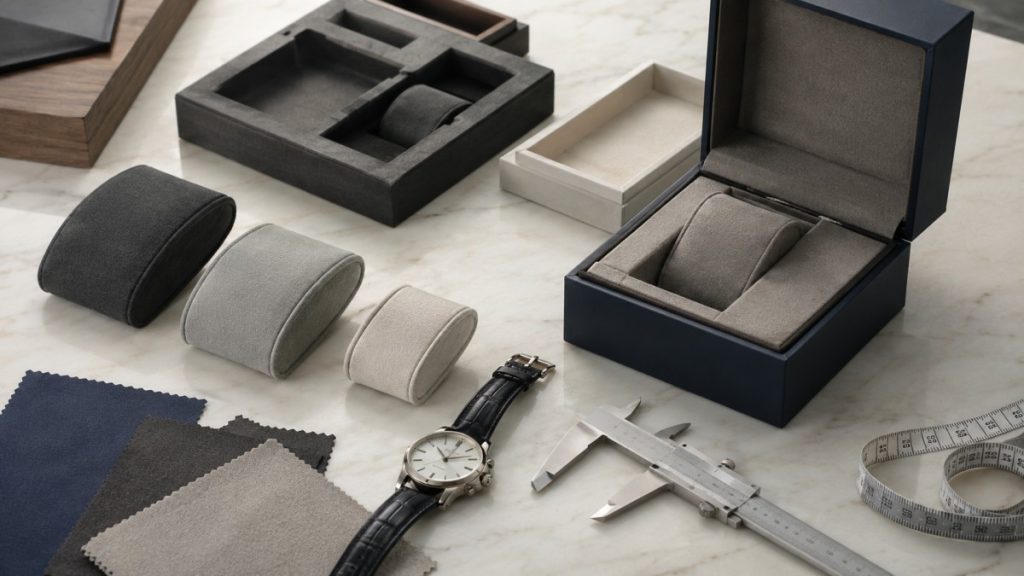
To ensure your custom watch boxes protect your timepiece perfectly, you must provide the exact physical dimensions and weight of the watch including its strap. Preparing these measurements prevents the watch from slipping, rattling, or sustaining cosmetic damage during transit or storage. When launching a luxury custom watch packaging project, accurate physical metrics are the absolute foundation of structural engineering.
Why watch thickness and case diameter matter
Case diameter (including the crown) dictates the minimum width of the internal cushion compartment, while case thickness determines the overall height clearance required inside the box lid. Band thickness and strap width define the channel size of the watch pillow, and total watch weight ensures the support structure is engineered with correct density materials. If these details are missing, your watch might sit too high and press against the inner lid, causing friction marks on the dial glass.
But that’s not all. You must also consider:
- Case diameter including crown (mm)
- Overall case thickness (mm)
- Strap width and strap thickness (mm)
- Total weight of the watch assembly (g)
Designing for different strap styles
Leather straps, metal bracelets, and rubber bands fold and rest in fundamentally different ways when wrapped around a watch pillow. A stiff steel bracelet requires a rigid, supportive cushion, whereas a soft leather strap needs a more flexible, compressible insert.
Here’s what you should check. Take note of how your watch rests naturally when buckled, as this influences the cushion’s circumference and tension.
- Strap flexibility and bending resistance
- Clasp mechanism height profile
- Total loop circumference when closed
Balancing box size with shipping weight
Large, heavy boxes look magnificent on retail shelves but can significantly inflate your global shipping and warehousing expenses. Finding the sweet spot between structural presence and logistical efficiency is crucial for overall profitability.
This is where many projects go wrong. Brands often design oversized display packaging without calculating the volumetric shipping impact.
- Standard physical volume limits
- Heavy-duty paperboard density options
- Multi-pack carton optimization factors
Key Takeaway: Providing precise product dimensions ensures your packaging offers optimal protection while preventing unnecessary dimensional weight charges during distribution.
| Watch Feature | Measurement Required | Impact on Box Design | |
|---|---|---|---|
| Case Diameter | Millimeters (mm) | Cushion slot width and clearance | |
| Total Weight | Grams (g) | Inner foam density and structural support | |
| Band Thickness | Millimeters (mm) | Cushion elasticity and wrap circumference |
The data above shows how minor variations in watch metrics directly dictate critical design clearances within the container.
What Box Style or Opening Structure Do You Prefer?
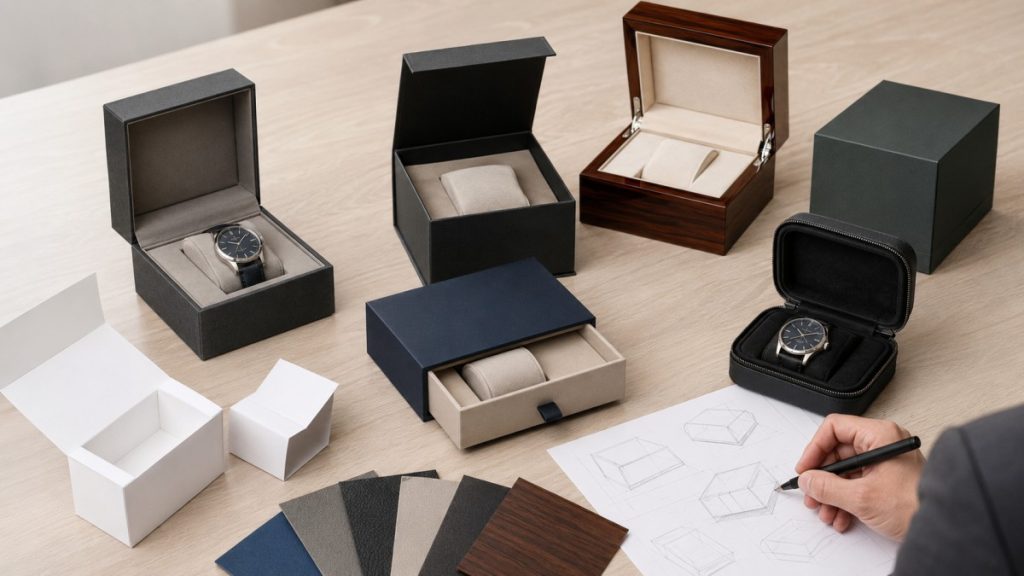
To choose the best box style or opening structure, you should select a mechanism that aligns with your brand’s tactile experience and your product’s market positioning. Deciding on the layout early allows us to calculate the required paperboard weight, hinge strength, and tooling costs accurately. Choosing a cohesive structure for your custom watch boxes establishes a memorable physical connection during your customer’s first unboxing moment.
Common box structures for luxury watches
Selecting the right style ensures your packaging matches your product’s market positioning and price point. Each structure demands different assembly times and hand-crafting steps.
Here’s what you should check. Take a close look at how these popular options impact structural complexity:
- Two-piece lift-off lid (classic & clean)
- Hinged shoulder box (premium collar look)
- Drawer style slide-out (modern & sporty)
- Book-style magnetic flap (satisfying click closure)
The mechanical function of hinges and closures
Hardware choices can make or break the premium feel of a hinged box. Premium metal hinges provide smooth, weighted resistance, while paper-groove hinges offer a clean, minimalist, and eco-friendly alternative.
This is where many projects go wrong. Cutting corners on hinge quality can result in lids that fail to stay open or align poorly after a few uses.
- Heavy brass and steel metal hinges
- Invisible paper-grooved ribbon hinges
- Embedded magnetic closures
Structural integrity and transit durability
Elegant styling must be backed by structural integrity to withstand the rigors of international shipping. Heavy-duty greyboard cores protect the contents from crushing forces and drop impacts during transit.
But that’s not all. You must ensure the structural walls do not collapse under pressure.
- Solid greyboard core density (800g to 1800g)
- Double-wall paper reinforcement options
- Corner-stay tape durability standards
Key Takeaway: Defining your box structure early allows our team to engineer the correct wall thickness and closure strength for ultimate product protection.
| Box Structure | Handcrafted Effort | Best Suited For | Key Aesthetic Value | |
|---|---|---|---|---|
| Two-Piece Lid | Moderate | Classic & Minimalist | Clean margins and symmetry | |
| Hinged Shoulder | High | Luxury & Heritage | Exquisite nested collar look | |
| Slide-Out Drawer | Moderate | Modern & Sporty | Contemporary, playful unboxing |
This structural comparison highlights how the opening mechanism influences both production complexity and overall brand perception.
What Design Files or Reference Samples Should You Send?
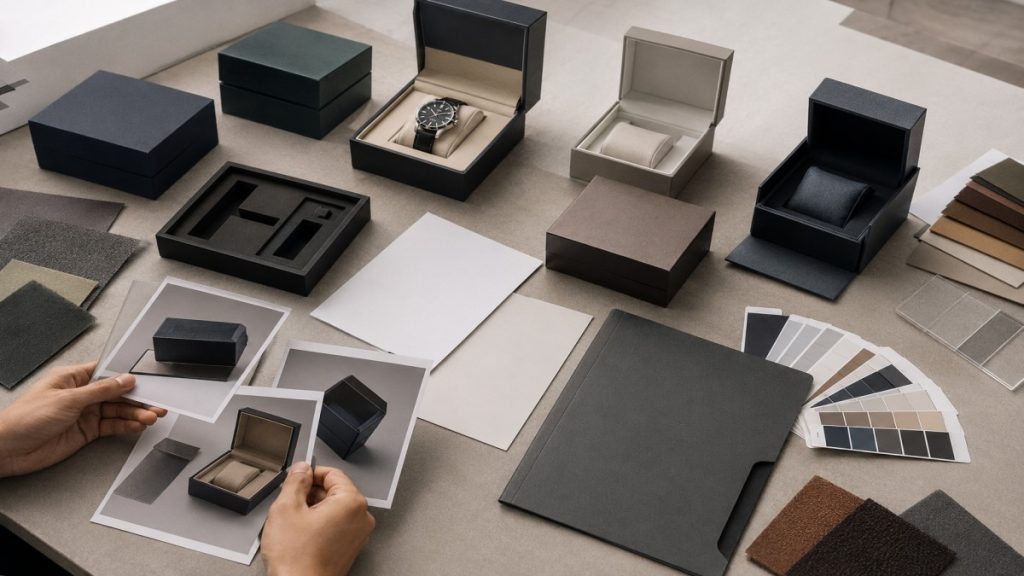
To verify if your design files or physical samples are ready, you should prepare editable vector artwork and 3D CAD files or prepare an existing physical reference box for our engineers. Providing clear, production-ready vector design files or physical reference samples drastically shortens the design-to-production lifecycle. When initiating a premium custom watch boxes project, these files give our engineering team a clear blueprint of your vision.
Technical file formats we work with
Adobe Illustrator is the preferred format for editing vector layers, dielines, and printing colors. Ensuring all text in your vector files is converted to outlines prevents font displaying issues.
Here’s what you should check. Make sure your design team has exported files in these correct formats:
- Adobe Illustrator (.AI) with all fonts outlined
- High-resolution Vector PDFs for print proofs
- STEP or IGES files for 3D mold-making inserts
Using physical reference samples to skip guesswork
If you do not have complex CAD files, sending a physical sample of a previous box is an outstanding shortcut. Our structural engineers can measure, reverse-engineer, and replicate its construction with extreme precision.
This is where many projects go wrong. Relying solely on flat photos often results in incorrect material tension and lid-fit expectations.
- Physical box samples of past projects
- Color swatches and material texture booklets
- Competing brand boxes for structural benchmarking
What is the pre-production proofing stage?
Once we receive your files, we generate a 3D digital rendering and a 2D technical dieline for your final approval. This process ensures that every hinge, magnetic flap, and inner cushion meets your standards before we start tooling.
But that’s not all. You must test your physical prototype with your real watch to ensure 100% security.
- 3D digital renderings and CAD layouts
- Unprinted physical white-samples (structural tests)
- Color-accurate digital or physical pre-production proofing
Key Takeaway: Prepared vector files and reference samples ensure the physical sample matches your initial creative design perfectly.
| File Format | Ideal Use Case | Font Status | Linked Images | |
|---|---|---|---|---|
| Adobe Illustrator (.AI) | Full layout & Dielines | Converted to Outlines | Embedded (High Res) | |
| Vector PDF | Reviewing proofs & placement | Outlined or Embedded | Embedded | |
| STEP / IGES | Mold design & insert cavities | N/A | N/A |
Utilizing correct digital asset formats prevents engineering delays and maintains the sharpest fidelity of your brand’s artwork.
What Exterior and Interior Materials Should You Specify?
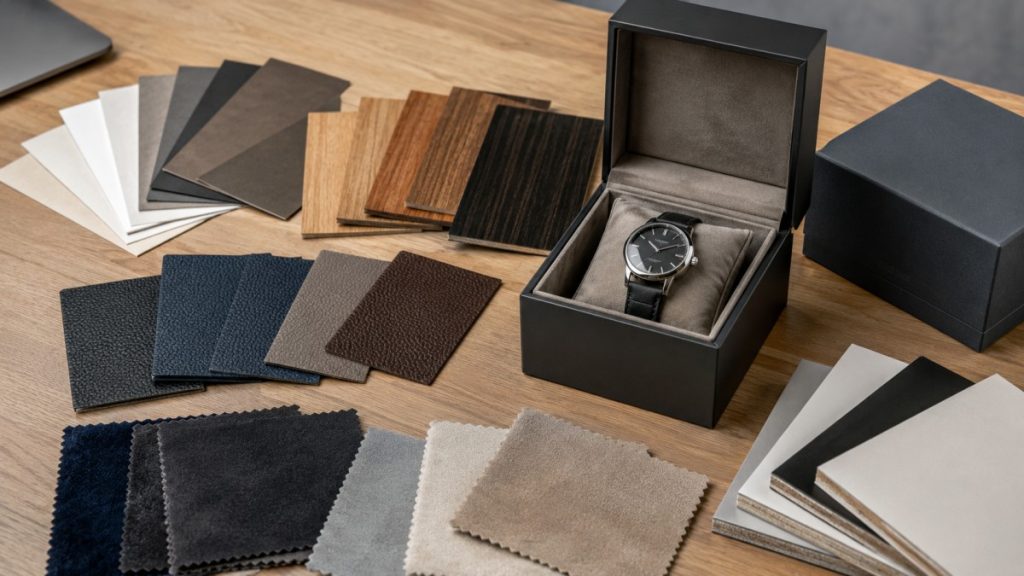
To choose the perfect materials, you must select high-quality materials for both the exterior wrap and interior lining that complement your brand’s aesthetic and values. Your choice of interior and exterior materials directly determines both the tactile premium feel and the final cost of your custom watch boxes . Selecting materials that align with your brand values helps us provide an accurate quote and avoid material sourcing delays later on.
Premium exterior wrapping options
Your exterior wrap choice dictates the printing techniques we can use. For example, hot stamping performs beautifully on PU leather, while complex offset printing is ideal for smooth papers.
Here’s what you should check. Let’s compare the most popular luxury wrapping options available for your brand:
- Specialty textured art paper (infinite designs)
- Premium PU leatherette (luxurious tactile feel)
- Genuine wood veneer (heritage classic look)
- Recycled kraft paper (eco-friendly visual style)
Lining materials for ultimate watch safety
The interior lining directly touches your watch, meaning it must be completely non-abrasive and visually stunning. Options like micro-suede, velvet, and micro-fiber prevent fine scratches on polished metal surfaces.
This is where many projects go wrong. Low-grade velvet can shed fibers that stick to watch crystals, which frustrates customers upon opening.
- Ultra-soft micro-suede (highly protective)
- Plush jewelry-grade velvet (traditional)
- Soft-touch microfiber (scratch prevention)
Balancing sustainability with luxury aesthetics?
Modern consumers increasingly demand sustainable materials without wanting to compromise on the luxury unboxing experience. We can source FSC-certified papers and water-based adhesives that look premium while protecting the environment.
But that’s not all. You can choose eco-friendly materials that match the high-end feel of premium packaging.
- FSC-certified recycled specialty papers
- Soy-based biodegradable printing inks
- Recycled plastic (RPET) interior fabrics
Key Takeaway: Specifying your material preferences during the quoting stage allows us to verify material availability and ensure chemical compatibility with watch finishes.
| Material Category | Tactile Experience | Eco-Friendly Option | Ideal Market Segment | |
|---|---|---|---|---|
| PU Leatherette | Soft, premium leather touch | Yes (Water-based PU) | Mid-to-High Luxury | |
| Specialty Paper | Endless textures & fibers | Yes (FSC-certified) | Modern Fashion / Indie | |
| Micro-Suede | Ultra-soft, plush feel | Yes (Recycled PET) | High-End Horology |
Evaluating these tactile options early ensures that your chosen materials perfectly reflect your brand values and satisfy environmental standards.
What Logo Files and Branding Details Should You Provide?
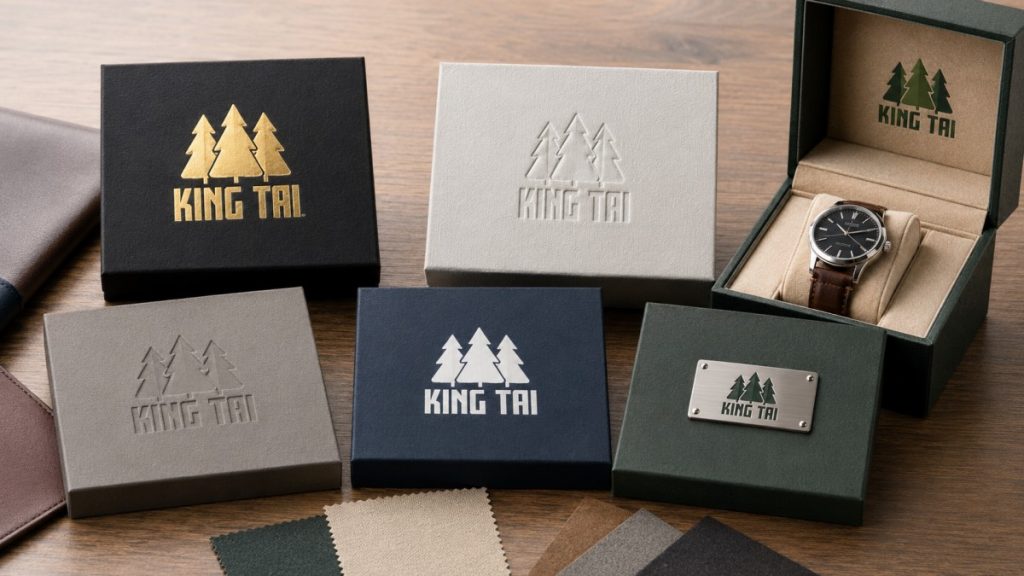
To decide on the best logo application method, you must select a decoration technique—such as foil stamping, debossing, or screen printing—that fits your material selection and visual style. The logo application method defines how your brand identity stands out on your custom watch packaging project. Different branding techniques require specific machinery and tooling setups, which directly impacts the initial pre-production setup costs.
Popular branding techniques for watch boxes
Combining techniques, such as a debossed border with a foil-stamped logo center, can elevate your brand’s presence. Choosing the appropriate match for your box design ensures a professional and clean result.
Here’s what you should check. Review these main finishing methods to see what matches your brand:
- Hot metallic foil stamping (gold, silver, rose gold)
- Precise blind debossing or embossing (tactile 3D feel)
- High-density silk-screen printing (sharp solid colors)
- Custom-engraved metal logo plates (premium luxury)
Selecting the right logo placement areas
Most watch brands choose to put their logo in high-visibility areas like the top outer lid and the inside lid lining. However, subtle placements like the side of the box or even on the watch pillow’s underside can add a beautiful element of surprise.
This is where many projects go wrong. Make sure your logo size is scaled proportionally so it does not crowd the box lid or get hidden by outer ribbons.
- Outer box lid center (prime real estate)
- Inner lid silk lining (visible when open)
- Bottom box base (for legal & compliance text)
What artwork formats are required?
For the sharpest logo execution, manufacturers require high-resolution vector artwork files with outlined fonts. Formats such as PDF, AI, or EPS ensure that the custom stamping plates are engraved with flawless precision.
But that’s not all. You must supply your brand guidelines to maintain exact color consistency across your branding surfaces.
- Vector formats: .AI, .EPS, or vector .PDF
- Pantones or exact metallic foil code specifications
- High-resolution typography outlines
Key Takeaway: Providing high-quality vector files up front prevents rasterization errors and ensures your finished logo is perfectly crisp.
| Branding Technique | Visual Impact | Best Material Match | Tooling Required | |
|---|---|---|---|---|
| Foil Stamping | Brilliant metallic shine | PU Leather & Paper | Custom Brass Die | |
| Debossing | Elegant, subtle depth | Matte PU Leather | Custom Copper Die | |
| Silk-Screening | Sharp, flat colors | Rigid Paperboard | Mesh Screen |
These graphic options show how each printing technique requires specific raw materials and unique setup tools.
What Interior Inserts or Accessories Should You Specify?
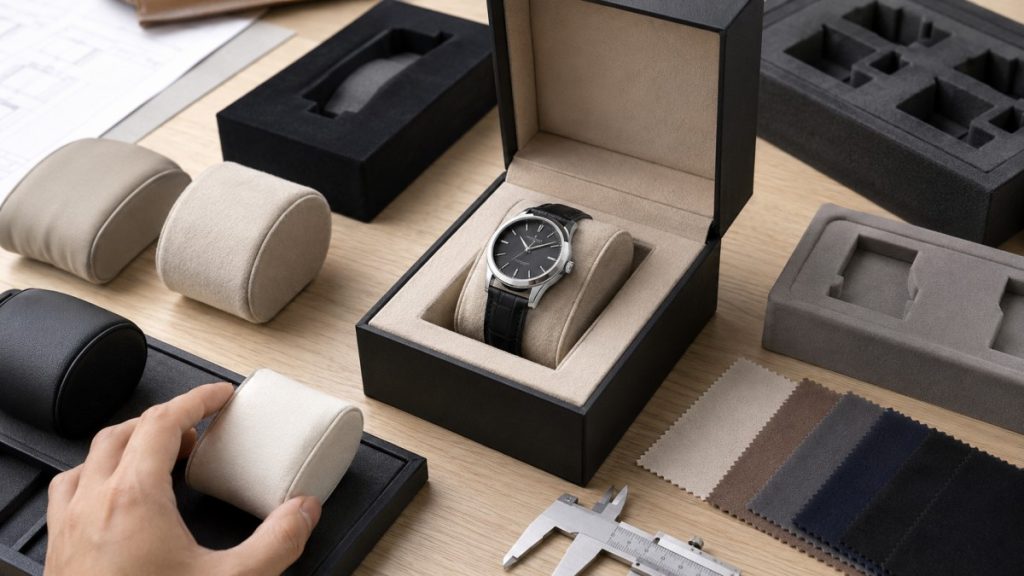
To decide on the custom inserts or accessories you require, you must identify whether standard cushions, high-density EVA foam, or multi-compartment layouts best support your watches. If you are unsure which interior style matches your brand, you can contact us directly to explore options for your custom watch boxes. These interior details ensure that every accessory is kept completely safe while showcasing your product’s craftsmanship.
Selecting the right insert materials
EVA foam is often laser-cut or CNC-routed, allowing for incredible precision that perfectly hugs the watch case and crown. Stuffed pillows provide a traditional, plush presentation that feels classic and premium.
Here’s what you should check. Evaluate the visual and protective benefits of these distinct insert materials:
- Laser-cut EVA foam (shockproof and modern)
- Molded paper pulp inserts (eco-friendly and sturdy)
- Traditional hand-stuffed pillows (plush and classic)
Incorporating extra accessory compartments
Many premium watch sets include extra strap options, spring bar tools, warranty cards, or cleaning cloths. Creating custom-fitted slots or hidden sub-compartments underneath the main watch deck keeps everything organized and safe.
This is where many projects go wrong. Forgetting to provide dimensions for manual booklets or certificates can result in items bending inside the box.
- Custom-cut spaces for alternative straps and tools
- Concealed drawer compartments for documentation
- Elastic ribbon slots inside the top cover
Ensuring safe watch transit and display?
An insert must prevent the watch from moving, even if the box is dropped or turned upside down during delivery. The cushion’s tension should be carefully calibrated to avoid stretching leather straps or stressing metal links.
But that’s not all. You must test physical fit compatibility to prevent any movement.
- Snug fit tolerances for the watch cushion cavity
- Cushion compressibility ranges for small/large wrists
- Secure friction-fit or magnetic tray locking
Key Takeaway: Well-planned insert layouts elevate the unboxing experience while protecting watch components from costly friction damage.
| Insert Material | Shock Protection | Aesthetic Style | Tooling Cost | |
|---|---|---|---|---|
| EVA Foam | High | Clean & Tech-forward | Low-to-Moderate | |
| Stuffed Cushion | Moderate-to-High | Classic & Cozy | None (Sewn) | |
| Flocked Plastic | Moderate | Structured & Seamless | Moderate-to-High |
The performance characteristics of internal materials outline the optimal trade-off between physical shock absorption and classic aesthetic display.
What Target Quantity Should You Share?
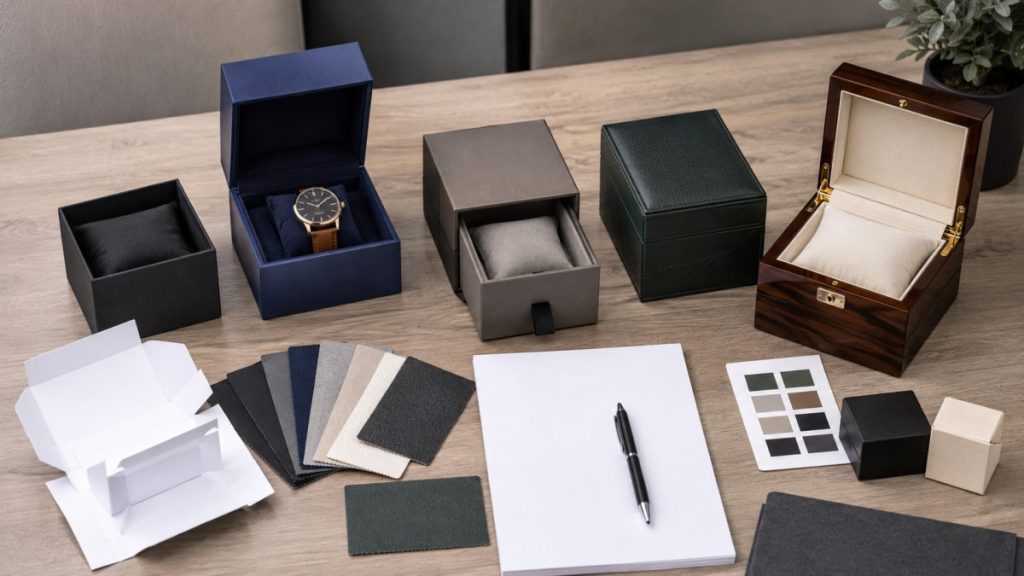
To determine your target order quantity, you must estimate the number of packaging units your brand plans to order for your initial launch and upcoming restocks. Your target order quantity is one of the most significant factors influencing unit production costs and manufacturing efficiency. As an established watch box manufacturer, we utilize advanced high-speed automated equipment alongside skilled hand-assembly stations to maximize efficiency and deliver top-tier custom watch boxes.
How production scale affects unit costs
Fixed setup costs for die-cutting, gluing, and printing machines are distributed across more units as the run grows. Larger volumes allow for highly economical sea or rail freight solutions compared to air courier.
Here’s what you should check. Look at how mass production economies of scale directly lower your costs:
- Volume discounts on specialty papers and materials
- Setup cost dilution across larger production batches
- Automated machine assembly versus manual labor cost
Planning for product launches and restocks
Brand owners often launch with a modest initial order to test the market before placing a much larger replenishment run. Having a clear forecast of your annual volume helps us secure raw materials and reserve production slots in advance.
This is where many projects go wrong. Forgetting to account for promotional seasons can lead to stockouts when your watch sales spike.
- Initial pilot launch quantities
- Holiday season packaging reserves
- Annual forecasted inventory runs
How to maximize value per order batch?
To get the absolute best value, consider consolidating different watch SKU boxes into a single production run with matching dimensions. This strategy keeps outer box sizes identical while using different colored linings or sleeve covers to differentiate watch models.
But that’s not all. You can negotiate better tier pricing by standardizing your box sizes across multiple watch lines.
- Multi-SKU size standardization
- Modular interior tray designs
- Custom outer sleeves for product variance
Key Takeaway: Outlining your immediate volume needs and future forecasts allows us to propose the most economical manufacturing process.
| Volume Tier | Manufacturing Style | Best For | Customization Scope | |
|---|---|---|---|---|
| Small Batch | High hand-craft ratio | Limited Editions / Tests | High material flexibility | |
| Medium Batch | Hybrid (Machine + Hand) | Established Indie Brands | Full structural custom | |
| Large Batch | Fully automated lines | High-Volume Retailers | Maximum cost efficiency |
This scaling model illustrates how order volume fundamentally determines the level of automation utilized during box assembly.
What Budget Range and Timeline Should You Confirm?
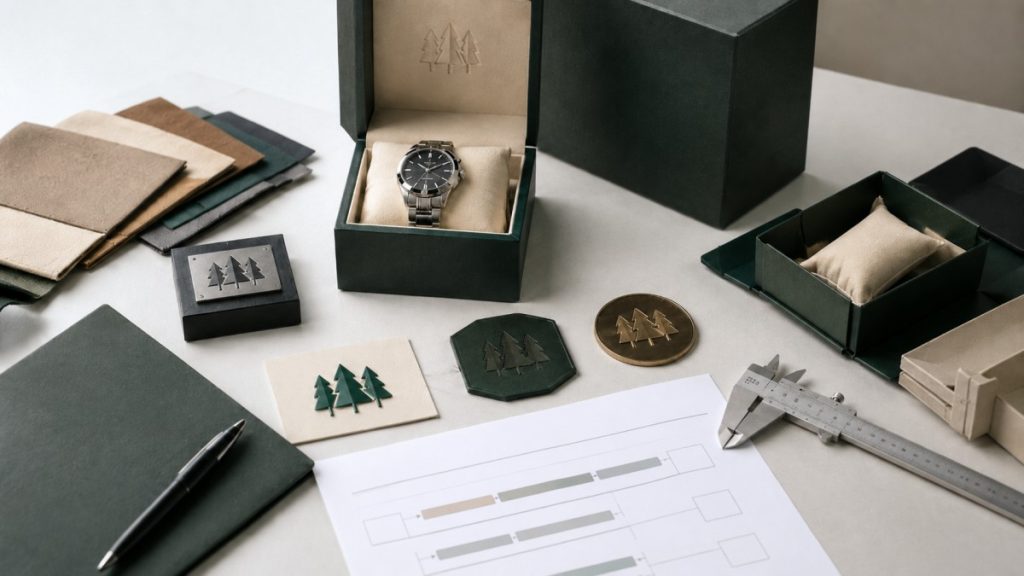
To set your target budget and timeline limits, you must calculate your ideal cost per box and establish your hard delivery deadlines before production begins. Sharing your target budget and delivery timeline helps a reliable manufacturer propose the most efficient materials and shipping methods for your custom watch boxes. Packaging manufacturing involves a balance between material costs, labor intensity, and transport speed.
Maximizing design options within your budget
Shaving a few millimeters off the box dimensions can save raw materials and packing space. Reusing existing molds for common box shapes eliminates high upfront tooling fees.
Here’s what you should check. Consider these tactical ways to optimize your production costs:
- High-quality textured paper instead of expensive PU leather
- Standard non-magnetic opening structures
- Reusing stock plastic or wood frame molds
Structuring realistic production timelines
High-quality, hand-assembled watch boxes require careful crafting, gluing, drying, and inspection steps. Rushing the process can compromise glue adhesion or result in minor cosmetic blemishes on delicate fabrics.
This is where many projects go wrong. Waiting until the last minute to order packaging can force you into expensive air freight options that eat up your product margins.
- Raw material sourcing lead time (10-15 days)
- Hand-assembly and gluing production time (20-30 days)
- Quality inspection and structural testing window (3-5 days)
How to plan for seasonal demand spikes?
Peak holiday seasons often see heavy congestion in both manufacturing schedules and international shipping lanes. Ordering your packaging several months in advance of your product launch protects your brand from unexpected delays.
But that’s not all. You must synchronize your box delivery with your final watch assembly schedule to avoid warehouse logjams.
- Holiday season production slot booking
- Sea transit buffer estimations (30-45 days)
- Backup shipping route planning
Key Takeaway: Clear communication about your budget and deadlines allows us to optimize the entire manufacturing workflow for on-time delivery.
| Phase | Key Activities | Critical Watchpoint | |
|---|---|---|---|
| Prototyping | Technical dielines, material sourcing, sample assembly | Check fit with physical watch | |
| Mass Production | Die-cutting, foil stamping, hand wrapping, QC | Reserve space before peak season | |
| Transit & Delivery | Quality checks, palletizing, custom clearance | Factor in local port customs |
This timeline breakdown illustrates how each distinct phase demands sufficient buffer time to guarantee exceptional product quality.
What Shipping and Packing Details Should You Share?
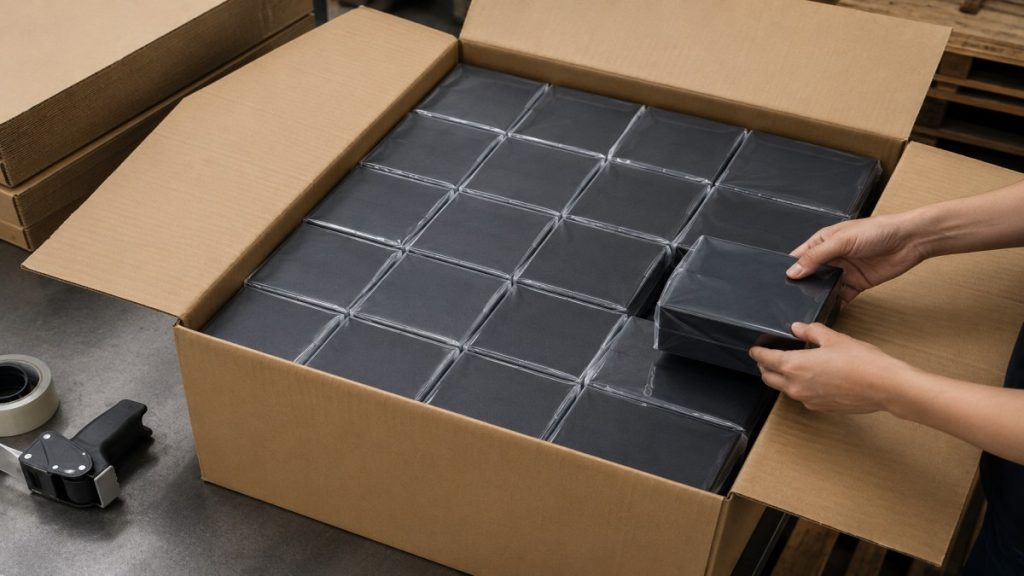
You should share the delivery country, shipping method, carton requirements, and any packaging restrictions before production starts. For custom watch boxes, good packing is not about adding more fillers. It is about using the right carton size, arranging the boxes tightly, and protecting each box surface properly.
What destination and delivery details should you provide?
Your supplier needs to know where the finished boxes will go and how they will be handled after shipping.
Here’s what you should check:
- Destination country or region
- Preferred shipping method
- Local packaging restrictions
How should the carton be designed around the box size?
The outer carton should be customized based on the finished watch box size and how many pieces can fit in one layer.
This is where many projects go wrong. If the carton is too large, the boxes may move during transport. If the carton is too tight without planning, the corners may get compressed.
A practical packing method usually includes:
- A custom-size corrugated carton
- Tight box arrangement
- Individual transparent protective bags
How does this reduce shipping risk and material waste?
A well-planned carton layout reduces movement, surface scratches, carton deformation, and wasted space. It also helps buyers meet stricter packaging or plastic-reduction requirements in some markets.
Key Takeaway: Share your destination, shipping method, carton needs, and packaging restrictions early. This helps the supplier design cleaner, safer, and more efficient packing for your watch boxes.
| Packing Detail | Why It Matters | |
|---|---|---|
| Custom carton size | Reduces empty space | |
| Tight box arrangement | Limits movement during shipping | |
| Transparent protective bag | Helps prevent surface scratches | |
| Carton loading quantity | Supports better shipping estimates | |
| Packaging restrictions | Avoids unsuitable materials |
This table shows that safer packing does not always mean adding more materials. The better approach is to control carton size, box arrangement, and surface protection from the beginning.
What Compliance or Testing Standards Should Be Confirmed?
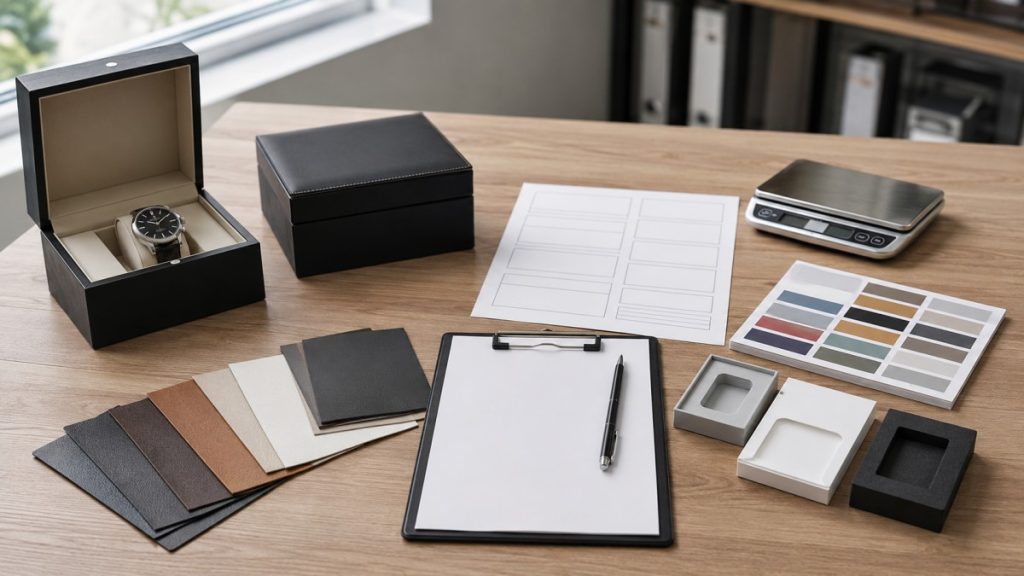
To determine which compliance or testing standards must be met, you must identify the environmental, chemical, and physical safety requirements of your target retail markets. High-end watch packaging must comply with regional environmental and safety regulations to ensure smooth distribution in retail markets. Declaring these safety expectations early guarantees your brand stays fully compliant when selling your custom watch boxes globally.
Essential packaging testing and certifications
FSC certification proves that the paper and wood fibers used are sourced from responsibly managed forests. RoHS and REACH compliance ensures all glue, inks, and synthetic leathers are free from harmful heavy metals and chemicals.
Here’s what you should check. Review the mandatory global safety standards required for your luxury packaging:
- FSC certification for sustainable wood and paper
- RoHS & REACH compliance for non-toxic materials
- California Proposition 65 chemical warnings compliance
Navigating regional packaging waste regulations
Many European countries require brands to pay eco-taxes or join recycling programs based on packaging weight and materials. Designing your boxes with easily separable elements—like removable foam inserts—makes them much easier for consumers to recycle.
This is where many projects go wrong. Ignoring local packaging waste laws can lead to severe fines or even retail bans in strict countries.
- Packaging recycling registration (e.g., Green Dot system)
- Removable and separable multi-material box elements
- Recycled cardboard and paperboard usage tracking
Do heavy magnets affect automatic movements?
Heavy magnetic closures can sometimes interfere with sensitive automatic mechanical watch movements if placed too close. We carefully test magnet placements and shielding options to ensure your watch’s timing precision remains perfectly unaffected.
But that’s not all. You can request specific magnetic shielding plates to protect ultra-sensitive high-end calibers.
- Mechanical calibration drift protection testing
- Shielding sheets for interior magnetic locks
- Non-magnetic mechanical button alternatives
Key Takeaway: Informing us of your required compliance standards ensures your custom boxes are ready for immediate sale in any target market.
| Certification Name | Focus Area | Essential Target Market | Compliance Value | |
|---|---|---|---|---|
| FSC | Sustainable Forestry | Europe & North America | Eco-conscious branding | |
| REACH / RoHS | Chemical & Ink Safety | European Union | Safe skin-contact materials | |
| ISTA Testing | Physical Drop Protection | Global E-commerce | Reduced transit damage |
The listed certifications illustrate the rigorous regulatory frameworks required to distribute commercial luxury packaging internationally.
Conclusion
Preparing the right project details before requesting a quote helps you avoid vague pricing, slow communication, repeated sampling changes, and production risks. Watch size, box style, material references, logo files, insert requirements, quantity, timeline, and shipping details all help your supplier recommend a more practical solution.
At King Tai Printing & Packaging, we help B2B clients turn watch packaging ideas into workable structures, samples, and mass production solutions. If you are preparing a custom watch box project, contact us today with your project details, and our team can help review the best next step.
Good watch packaging should not only protect the product. It should help your brand present value, control risk, and prepare for long-term growth.
Frequently Asked Questions
Can I request a quote without a finished box design?
Yes. You can request a quote without a finished design, but you should still provide basic project details such as watch size, preferred box style, logo file, quantity, budget range, and target delivery date. With these details, a supplier can recommend a practical structure, material, insert, and finishing direction before moving into sampling.
What should I send if I do not know the material name?
You can send reference photos, existing packaging samples, texture examples, color direction, and your target budget. A professional packaging supplier can use these references to identify suitable options, such as rigid paperboard, PU leather texture, wood finish, specialty paper, velvet, or microfiber lining.
What logo file format should I prepare?
The best format is a vector file, such as AI, PDF, or SVG. These files help the supplier keep your logo sharp and accurate for foil stamping, embossing, debossing, printing, or metal logo plates. If you do not have a vector file yet, you can send a high-resolution image for early discussion.
Can I start the project without sending a physical watch?
Yes, but accurate measurements are important. You should provide the watch case size, thickness, strap type, strap width, watch weight, and lug-to-lug length if available. A physical watch or sample is still helpful before final sampling, especially when confirming the pillow fit and insert structure.
What is the best way to reduce sampling revisions?
The best way is to prepare a clear project brief before contacting the supplier. Include watch details, box style, material references, logo files, insert requirements, order quantity, budget range, timeline, shipping destination, and reference images. Clear information helps the supplier give a more accurate quote and reduces repeated changes during sampling.