
What is a reference Bible? It is a Bible edition that adds navigation aids, especially cross-references, to the main text so readers can follow related passages without leaving the page. The reference system may also include footnotes, a concordance, indexes, maps, or other study aids, depending on the edition.
For a publisher, those additions are production decisions as well as editorial decisions. Cross-reference markers need space, small supporting type needs a readable page, and extra apparatus can change page count, paper bulk, binding, cover, and sampling. The right way to plan the edition is to define the reference system first, then build the physical book around it.
What is a reference Bible?
A reference Bible keeps the main biblical text at the center and adds tools that help readers locate related passages or supporting information. Its exact feature set can vary, so “reference Bible” should be treated as an edition direction that still needs a written content and layout brief.
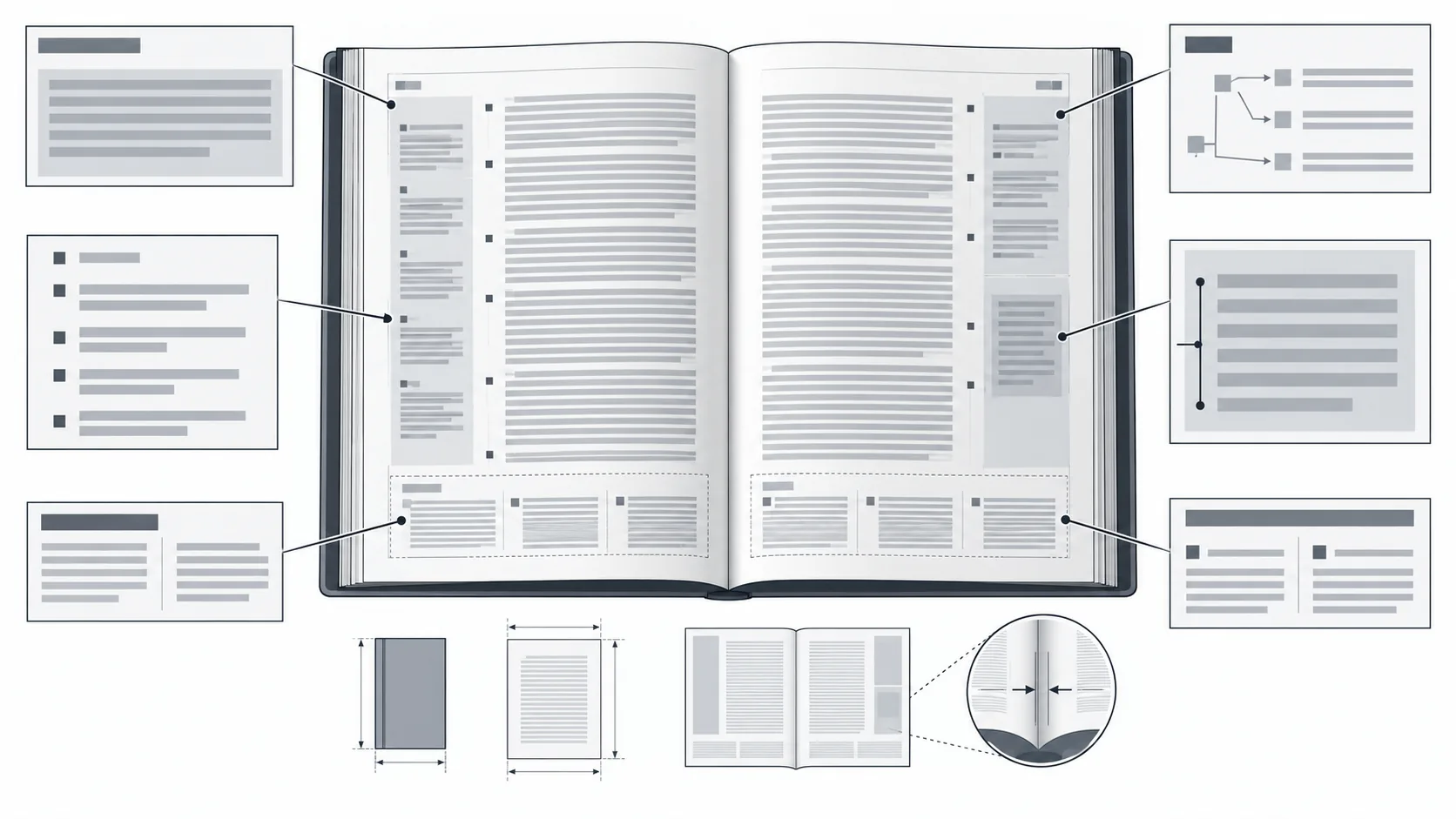
Which features make an edition reference-led?
Start by listing the aids the reader will use. King Tai’s custom Bible printing page frames Bible projects around use, audience, paper, binding, sampling, and production planning, which is the same order a publisher needs for a reference edition.
Common reference features include:
- Cross-references that point to related passages.
- Footnotes or short notes attached to the text or reference markers.
- Concordances, indexes, maps, or book introductions.
- Navigation cues that help readers move between the main text and the apparatus.
| Feature | Reader task | Production consequence |
|---|---|---|
| Cross-references | Find related passages | Needs markers, destinations, and space |
| Footnotes | Read compact supporting notes | Changes type hierarchy and page density |
| Concordance or index | Search names, terms, or topics | Adds pages and back-matter planning |
| Maps or visual aids | Locate places or context | Requires image reproduction and inserts |
The label becomes useful when the feature list is precise. Key Takeaway: define the reference apparatus before treating the edition as a finished product type.
How does a reference Bible differ from a text-only Bible?
A text-only Bible prioritizes uninterrupted reading of the main text, while a reference Bible adds navigation or supporting tools that compete for page space. Neither direction is automatically better; the choice follows the reader’s task and the publisher’s editorial scope.

What changes when references are added?
The page must support two reading movements: following the primary text and checking an associated reference. The Scripture publishing solutions page emphasizes matching format and production decisions to the intended publishing project, which helps a team decide how much apparatus the edition should carry.
Compare the directions:
- Text-only: cleaner pages and fewer navigation elements.
- Reference: denser pages with cross-reference markers or notes.
- Hybrid: a focused set of references with selected back matter.
- Study-led: reference tools plus larger amounts of commentary or interpretation.
| Edition direction | Reader experience | Layout consequence | Buyer question |
|---|---|---|---|
| Text-only | Continuous reading | More open page | Is navigation outside the page acceptable? |
| Reference | Text plus related passages | More markers and supporting type | Can the reader scan both levels comfortably? |
| Hybrid | Focused support | Controlled density | Which tools deserve page space? |
| Study-led | Text plus extensive editorial material | Larger content architecture | Is the scope still a reference edition? |
Adding features changes the product, not just the page count. Key Takeaway: decide whether the edition serves uninterrupted reading, navigation, or broader editorial study before choosing layout.
How do cross-references work on a Bible page?
Cross-references connect a marker in the main text to a citation elsewhere in the edition, often through a center column, margin area, footnote zone, or page-bottom system. The placement should help the reader move from marker to destination without losing the text line.
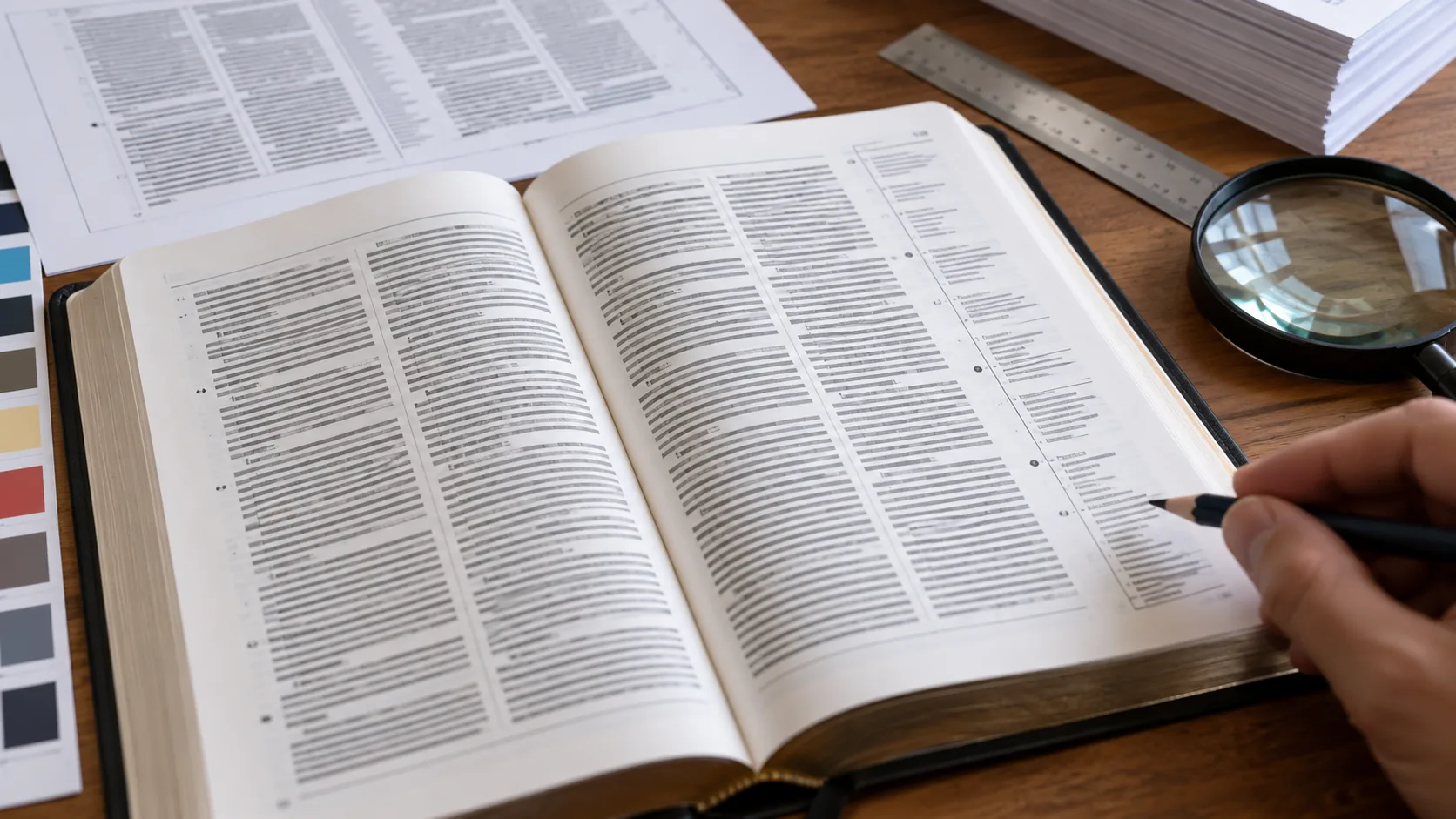
Which placement should a publisher evaluate?
Evaluate the reference location beside the type size, columns, margins, and page rhythm. A publisher can compare the navigation logic on a custom Bible printing project by testing a representative spread before the full file is locked.
Check:
- Marker visibility beside the main text.
- Distance between marker and reference list.
- Destination citation length and line wrapping.
- Page balance when a passage has few or many references.
| Placement | Strength | Risk | Proof check |
|---|---|---|---|
| Center column | Keeps references close to two text columns | Reduces central whitespace | Test marker scanning and column width |
| Outer margin | Keeps the main text visually open | References may feel farther away | Review page turns and margin space |
| Footnote area | Groups notes below the text | Can make the lower page dense | Check line length and hierarchy |
| Page bottom | Creates a defined apparatus zone | May compete with footers | Review the full spread at reading size |
Cross-reference placement is a navigation decision with physical consequences. Key Takeaway: approve markers, destinations, and page balance as one reference system.
What roles do notes, footnotes, and indexes play?
Notes, footnotes, indexes, concordances, maps, and book introductions each add a different layer of support, so they should not be treated as interchangeable reference content. Some help readers navigate; others add editorial explanation or search depth.
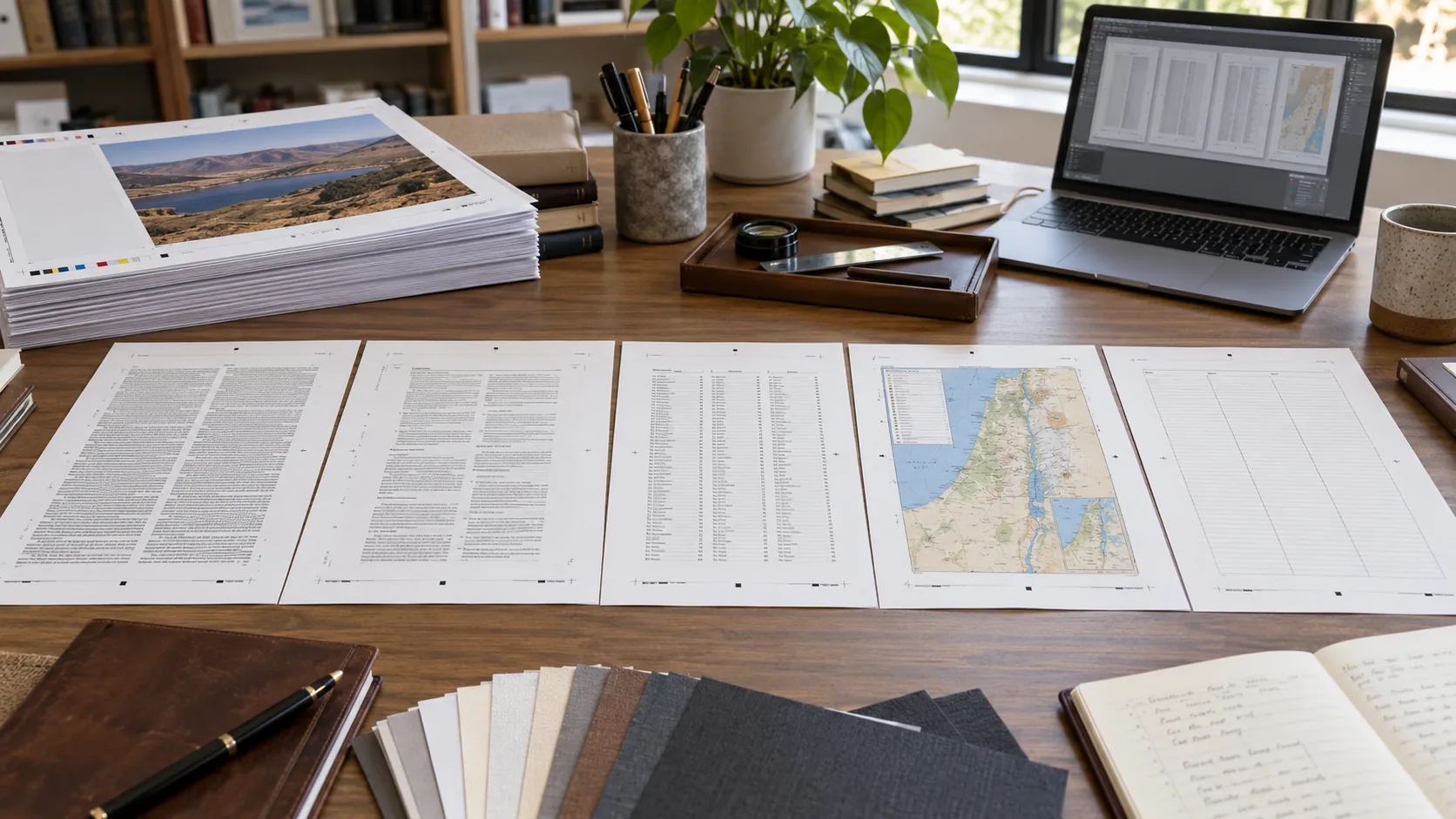
How should the apparatus be scoped?
List every component before estimating page count. The custom printing services workflow supports this kind of scope review because content format, page planning, materials, binding, sampling, and delivery need to stay aligned.
Separate the functions:
- Cross-reference: points to a related passage.
- Footnote: attaches a compact note to a text location.
- Concordance: supports term-based lookup in the back matter.
- Index: organizes names, topics, or other navigation keys.
- Map or introduction: adds visual or contextual material.
| Apparatus | Primary function | Reference/study relevance | Production question |
|---|---|---|---|
| Cross-reference | Navigate to related text | Core reference feature | How will markers and destinations be set? |
| Footnote | Attach a short note | May support reference or study scope | What type hierarchy keeps it readable? |
| Concordance | Search terms | Common in reference-led editions | How many pages and columns are needed? |
| Index | Find names or topics | Useful when navigation is a priority | What keys and sorting rules are required? |
| Maps or introductions | Add visual or contextual support | Often expands toward study scope | How will images and inserts be reproduced? |
The feature list should be complete before the page budget is approved. Key Takeaway: name each apparatus item and its function before the design team estimates pages.
How does a reference system affect Bible page layout?
A reference system affects columns, type hierarchy, leading, margins, markers, line matching, and page balance. The page has to remain readable while giving the supporting information enough space to function.
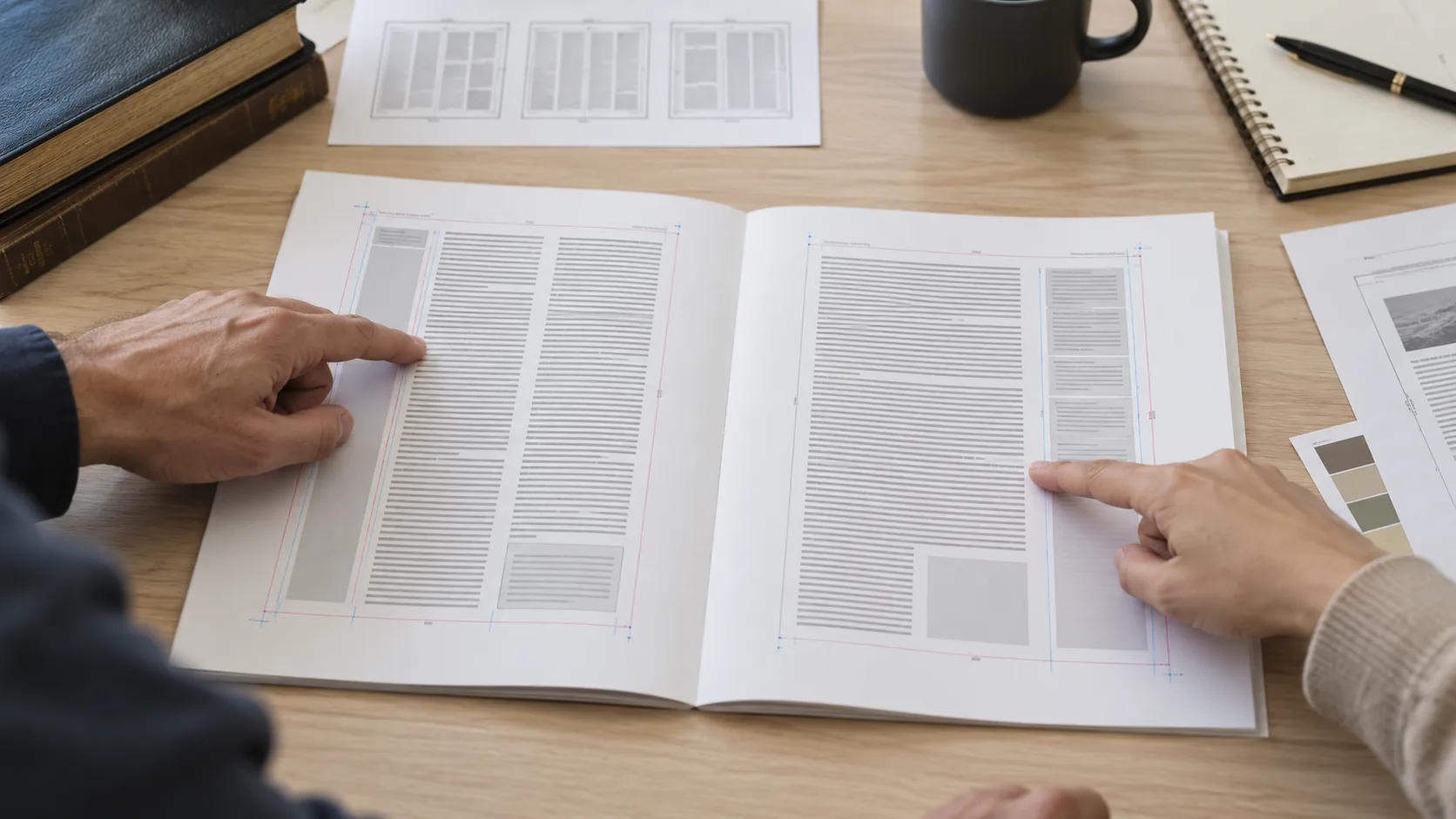
Which layout variables need a coordinated decision?
Use a representative spread rather than a single text page. A page in the Bible dimensions guide shows why trim, spine, page count, and final physical dimensions belong in the same planning conversation, even when the reference apparatus is the immediate topic.
Review:
- Single-column or multi-column main text.
- Text type, reference type, markers, and line spacing.
- Margin width, reference zone, and running elements.
- Page balance across short and dense passages.
| Layout variable | Reader effect | Production check |
|---|---|---|
| Column count | Changes line length and scanning | Proof the main text with markers present |
| Type hierarchy | Separates text from references | Check small type at actual reading size |
| Margins | Creates space for notes or references | Confirm trim and binding allowances |
| Line matching | Helps pages feel orderly | Check alignment across facing pages |
| Reference density | Controls visual load | Test a dense passage and an open passage |
The cleanest page is not always the most useful page. Key Takeaway: protect readability while giving the reference system enough space to be navigable.
How do paper and print choices affect a reference Bible?
Paper and print choices affect opacity, type clarity, page bulk, color reproduction, and the comfort of navigating dense pages. A reference edition may place small supporting type, maps, or other visual material beside the main text, so the paper decision must support both readability and information density.

What should be tested before paper approval?
Paper should be evaluated with the actual type hierarchy, reference markers, and image or map content. King Tai’s custom Bible printing page highlights paper, binding, sampling, and quality control as connected decisions rather than separate purchases.
Test:
- Show-through behind small reference type.
- Clarity of fine lines and markers.
- Contrast between main text and supporting type.
- Page-block bulk, turning, and binding fit.
| Requirement | Paper or print concern | Sample check |
|---|---|---|
| Small reference type | Opacity and fine-line clarity | Review a dense reference spread |
| Maps or visual aids | Color and detail reproduction | Test representative images |
| Thin page block | Show-through and handling | Turn pages under normal light |
| High page count | Bulk and spine effect | Review a bound dummy |
Paper is part of the reading interface. Key Takeaway: approve paper with the smallest type, densest spread, and final binding context in view.
How do binding and cover choices affect daily use?
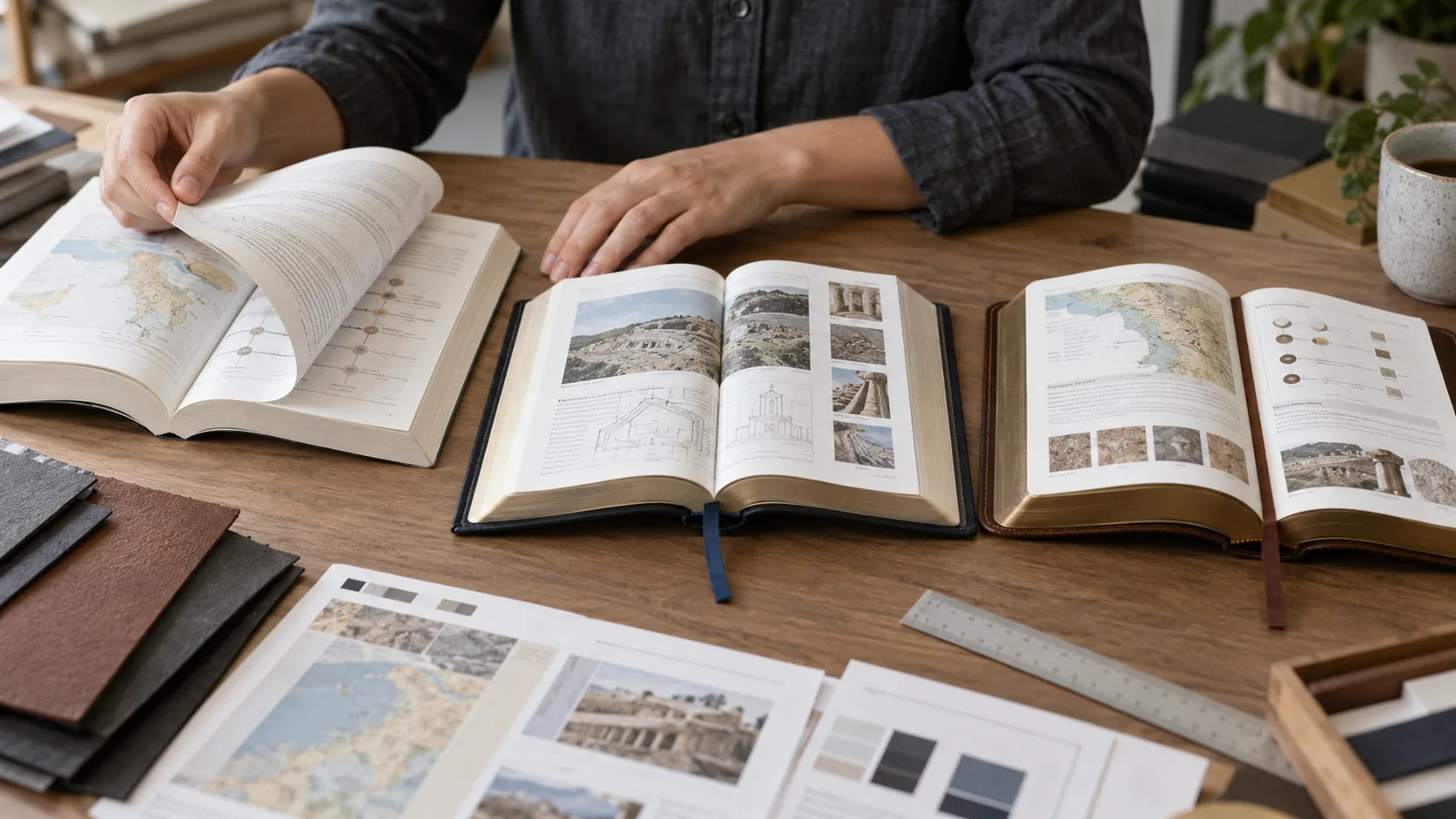
Binding and cover choices affect how a reference Bible opens, stays supported, and survives repeated page navigation. A publisher may choose a sewn, hardcover, flex, or other construction direction, but the correct choice depends on page block, handling, cover position, and use cycle.
What should a physical sample prove?
A sample should prove that the reader can open the book to a reference passage, hold it comfortably, and return to the main text without stressing the structure. The custom Bible printing page frames sampling and production control as important checkpoints before volume work.
Check:
- Opening behavior at the center and near the front or back.
- Spine, cover, and page-block balance.
- Page turning around reference-heavy sections.
- Cover and finish performance under repeated handling.
| Use condition | Construction concern | Approval check |
|---|---|---|
| Frequent study or teaching | Opening and page hold | Navigate several references repeatedly |
| Retail handling | Cover and finish presentation | Inspect edges, corners, and shelf display |
| Gift or commemorative use | Material feel and protection | Review closed and open presentation |
| Portable use | Weight, trim, and page support | Carry and read from the sample |
The reader experiences the reference system through the physical book. Key Takeaway: approve opening and handling with reference-heavy pages, not only with a clean cover sample.
How should publishers choose reference or study features?
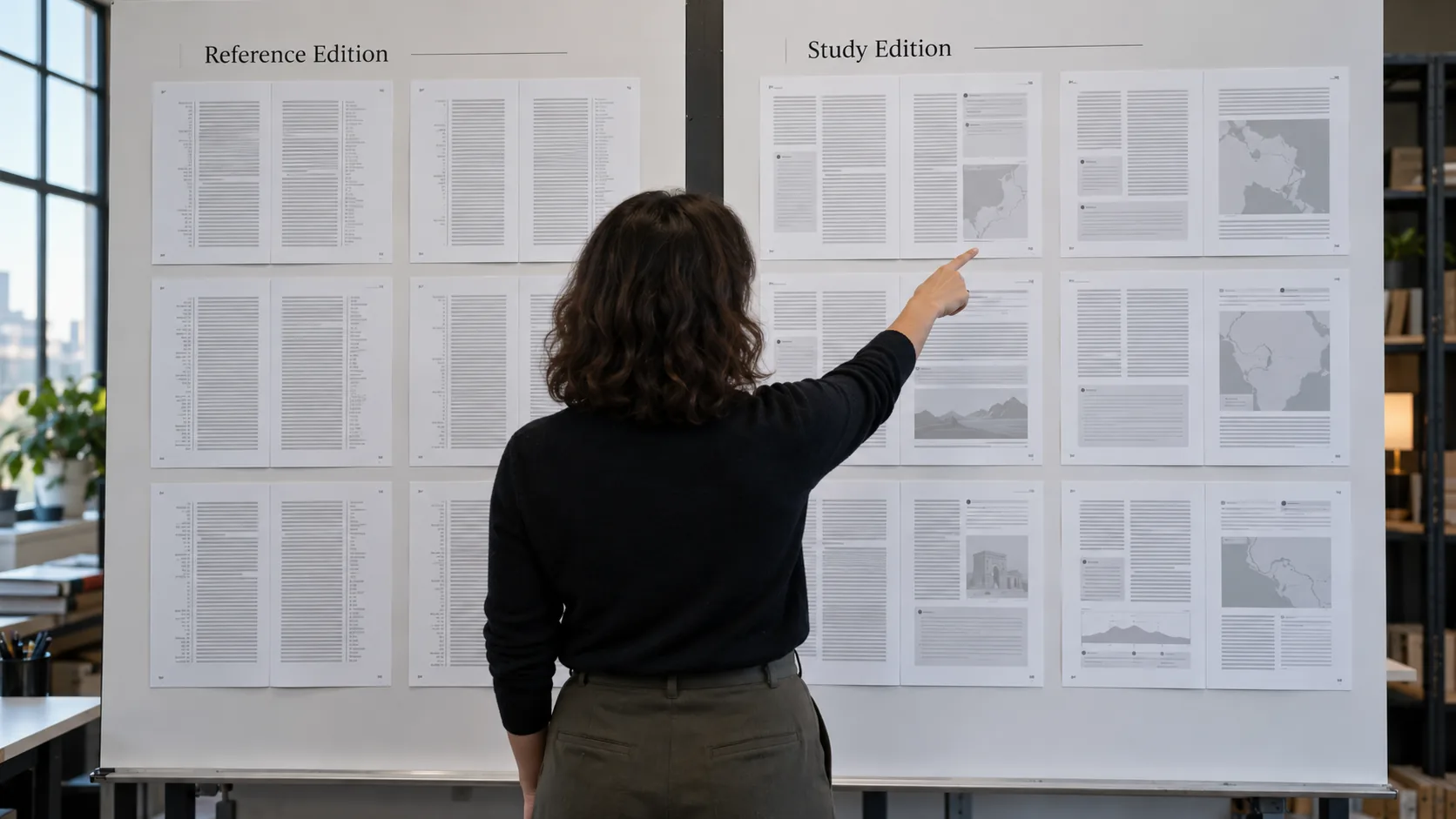
Publishers should choose a reference-led direction when navigation aids are the main addition, and a study-led direction when the edition also carries substantial commentary, historical context, maps, or interpretive material. The distinction is about editorial scope, not a judgment about which edition readers should prefer.
Which scope fits the intended edition?
Use the project goal to decide how much supporting material belongs on the page. The Scripture publishing solutions page supports planning around audience, format, readability, materials, binding, and production rather than starting with decoration.
Define the scope:
- Reference-led: cross-references and navigation aids around the main text.
- Reference plus back matter: cross-references with concordance, index, or maps.
- Study-led: reference aids plus broader commentary or educational content.
- Wide-margin or journaling: space for the reader’s own notes and interaction.
| Editorial direction | Apparatus | Reader/product fit | Production consequence |
|---|---|---|---|
| Reference-led | Cross-references and navigation | Readers who want connected passages | Plan markers and reference zones |
| Reference plus back matter | References, indexes, maps | Readers who need lookup tools | Add page and image planning |
| Study-led | Notes, context, commentary, maps | Structured study programs | Larger editorial and layout scope |
| Wide-margin or journaling | Space for personal notes | Readers who annotate | Requires margin and paper planning |
Editorial scope should be settled before the page design becomes expensive to change. Key Takeaway: choose the reference or study boundary first, then build the format and budget around it.
What should a reference Bible printing RFQ include?
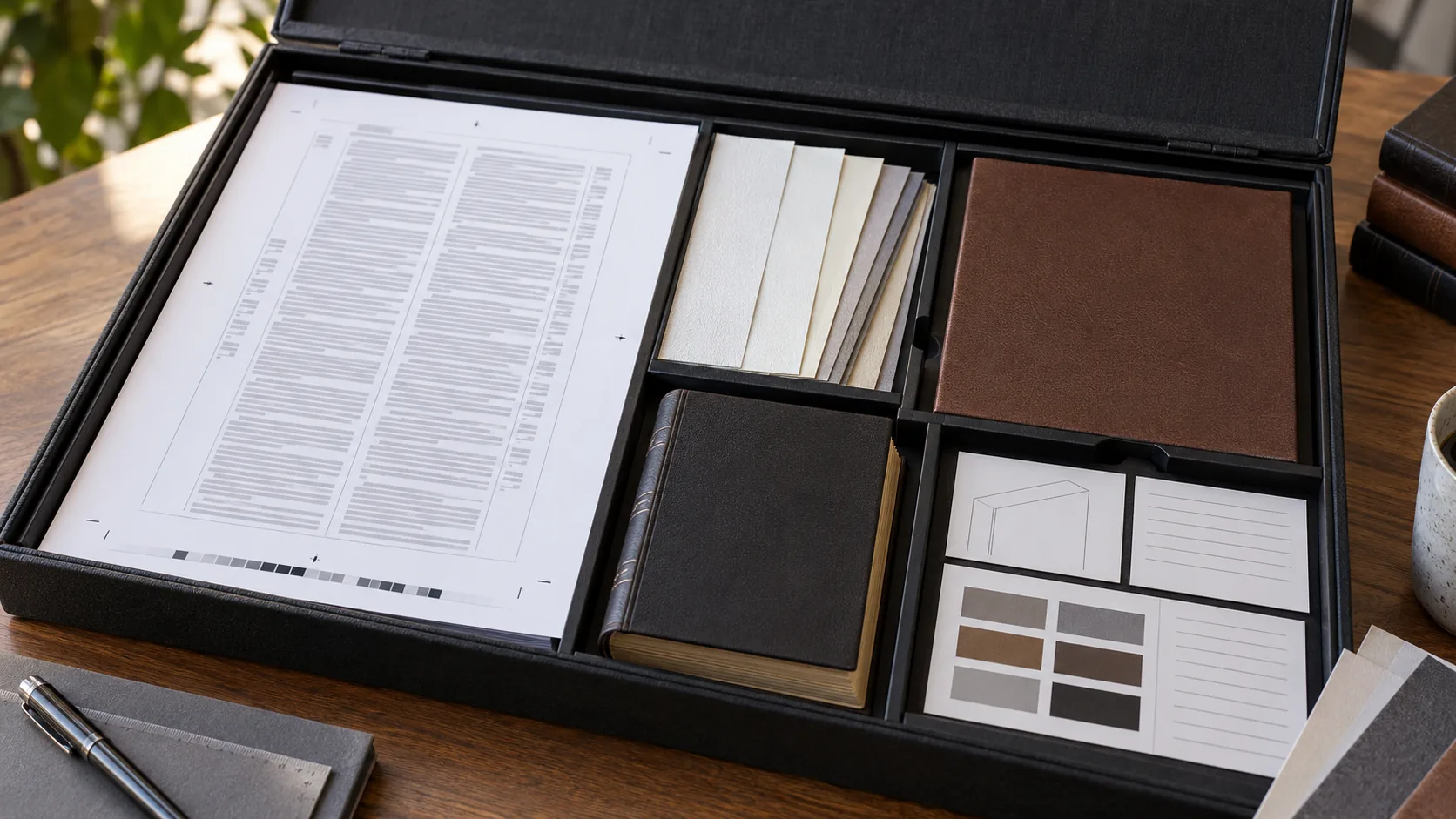
A reference Bible RFQ should state the text and file source, cross-reference system, notes, indexes, maps, columns, type hierarchy, trim, paper, binding, cover, quantity, packing, destination, and approval standard. The buyer should also identify which elements are fixed and which are open to layout recommendation.
How can a publisher make the first quotation useful?
Use the custom Bible printing requirements discussion to send content architecture and physical requirements together. If files are still developing, state the expected apparatus and ask the supplier which decisions must be locked before sampling.
Include:
- Text files, translation information, and reference data.
- Cross-reference, footnote, concordance, index, and map requirements.
- Column, type, margin, trim, page, paper, and binding direction.
- Cover, finishing, quantity, packaging, destination, and repeat-order plan.
- Sample, proof, color, and approval standard.
| RFQ field | Useful wording | Why it matters |
|---|---|---|
| Text and apparatus | “Main text plus cross-reference file and concordance” | Defines the editorial input |
| Layout | “Two columns with reference zone under review” | Sets the design question |
| Physical format | “Trim, paper, page count, binding, cover” | Makes the book buildable |
| Quantity | “_ units across _ editions” | Supports production planning |
| Approval | “Bulk follows approved spread and bound sample” | Creates a review reference |
A clear RFQ lets the supplier price and sample the edition from the same assumptions. Key Takeaway: describe the content architecture and physical book together.
How should a publisher choose the right reference Bible format?
Choose the format by defining the reader’s navigation task, then specify the cross-reference apparatus, layout, type hierarchy, paper, page block, binding, cover, and sample standard. A reference Bible should make related passages easier to find without making the main text tiring to read.
King Tai can discuss Bible printing projects with publishers, ministries, and faith-based brands before the production direction is fixed. Share the edition goal, text files, reference requirements, rough format, quantity, and references through contact us today. A clear editorial brief gives the physical specification a reliable starting point.
Can a reference Bible include study notes?
Yes, but the editorial scope should be stated clearly. Cross-references are navigation aids, while substantial commentary or historical material moves the edition toward a study-led product.
What is the most important reference Bible layout decision?
The relationship between main text, markers, and reference destinations is central. Choose a placement that readers can scan without losing the text line.
Do reference features always make a Bible longer?
Often they add content and page pressure, but the result depends on the apparatus, typography, columns, and page architecture. Confirm the page estimate after layout planning.
What paper should a publisher use for a reference Bible?
Choose paper through a sample that tests opacity, fine type, maps, page turning, and binding fit. The right stock depends on the complete edition specification.
What should I prepare before requesting a reference Bible quotation?
Prepare text files, cross-reference data, notes or index requirements, layout direction, trim, paper, binding, cover, quantity, destination, and approval expectations.