A stationery buyer may approve a good-looking sample, then find that it opens badly, feels wrong, or changes in production. That creates rework and an inconsistent product line. Notebook types are best chosen by the job the product must do, then by the page system, cover, and binding that support it.
Classify the notebook by market use first, then turn that choice into a written specification. The sections below connect common formats to office, education, gifting, and retail decisions.
What are the main types of notebooks for a product line?
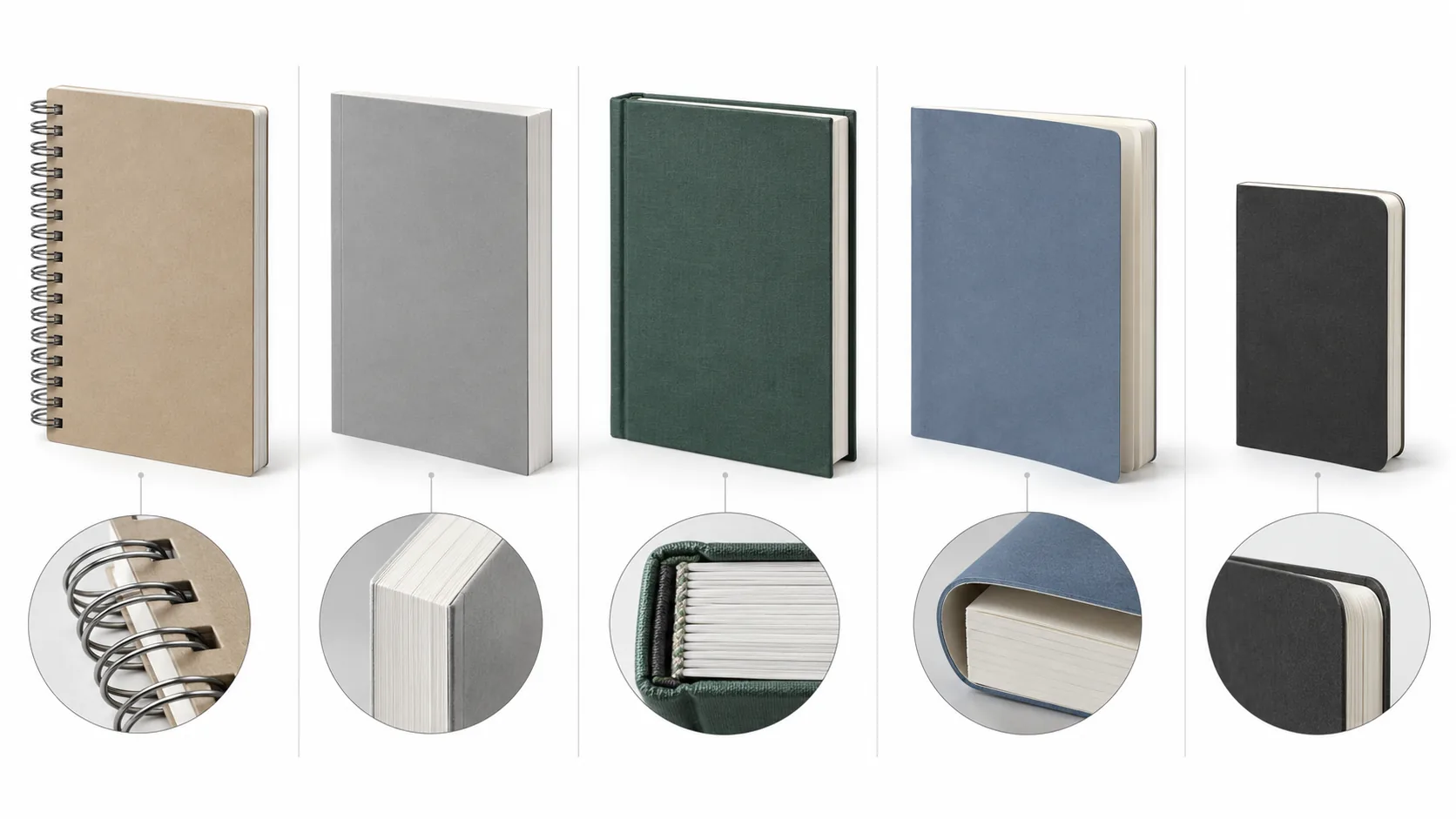
The main notebook types are spiral or Wire-O, bound, hardcover, softcover, composition or academic, pocket, planner or guided, and subject notebooks. Labels can overlap: a retail journal may be hardcover and sewn, while a school notebook may be softcover and spiral-bound.
How should you use a notebook type map?
Use the type as a planning map, not as a finished specification. A buyer choosing a custom notebook printing service should connect the label to the user, the interior task, and the construction that can deliver it.
The practical split is this:
- Use case: who will write in it and where.
- Interior: ruled, blank, dot-grid, graph, planner, or content-led pages.
- Construction: cover, page count, binding, finish, and pack.
| Notebook type | Core use | Decisions to define | Procurement caution |
|---|---|---|---|
| Spiral or Wire-O | Practical writing and training | Opening, coil, page stock | Check edge and page hold |
| Bound or perfect bound | Journals and retail lines | Spine, pages, cover, opening | A clean look may not open flat |
| Hardcover or sewn | Gifts and premium retail | Board, covering, sewing, finish | Check weight and balance |
| Softcover | Campaigns and portable use | Cover stock, flex, binding, pack | Flexible cover still needs protection |
| Composition or subject | Classroom and organized notes | Ruling, sections, dividers | Define the interior before quoting |
| Pocket or guided | Portable or structured content | Trim, prompts, page architecture | Match compact size to the task |
Key Takeaway: name the market job first, then specify the interior and construction that support it.
Which notebook formats suit office and everyday writing?
Practical notebook formats support repeated writing, quick page access, and comfortable handling. Office notes, meeting records, and everyday lists need a useful writing area, clear page organization, and a binding that matches how the book will be opened.

What should buyers specify for practical use?
Start with the way the user handles the notebook, then choose the format. King Tai’s stationery and gifting printing solutions separates retail, training, internal, and event use cases.
Check these points before approving a sample:
- Portability: Will the user carry it or leave it on a desk?
- Opening: Does it need to lie flat, turn easily, or protect a clean spine?
- Interior: Are ruled, blank, or grid pages right for the work?
- Handling: Does the cover and page block stay stable after repeated opening?
| Format | Strength for office use | Trade-off | Useful check |
|---|---|---|---|
| Spiral or Wire-O | Easy turning and practical access | Wider spine and exposed edge | Open, fold back, and inspect the edge |
| Softcover bound | Light, flexible, and easy to distribute | Less protection than a hard cover | Check cover flex and corner wear |
| Perfect bound | Clean book-like presentation | May resist flat opening | Test writing near the spine |
| Hardcover journal | Stronger presentation and protection | More weight and material | Check hand feel, weight, and balance |
Convenience and presentation can pull construction in different directions. Key Takeaway: handle an office notebook as a user would instead of reviewing the cover image alone.
Which notebook types work best for education and training?
Education and training notebook types should make the page task obvious, keep notes organized, and withstand repeated handling. Composition, subject, spiral, and softcover formats can all work, but the interior usually matters more than the cover.

How do page systems change classroom use?
Define what the user must record before choosing the notebook. For a school or training project, custom printing services can cover content format, page layout, binding, and sampling instead of treating the job as a generic blank book.
Useful interior choices include:
- Ruled pages for handwriting, meeting notes, and language practice.
- Grid pages for calculations, diagrams, and structured exercises.
- Subject sections for separating classes, modules, or projects.
- Reference pages for instructions, tables, or recurring prompts.
| Page system | Suitable use | Buyer question |
|---|---|---|
| Ruled | General notes and handwriting | What line spacing supports the intended user? |
| Grid | Maths, technical notes, diagrams | Will the grid remain clear at the selected print size? |
| Blank or dot-grid | Sketching and flexible planning | Are margins and grid visibility right? |
| Subject sections | Multi-class or multi-module work | How many sections, dividers, and pockets are needed? |
The right interior reduces correction later because page logic is settled before cover artwork. Key Takeaway: for education and training, specify the page system and section structure before selecting decorative finishes.
How should brands choose notebooks for gifts and promotions?
Gift and promotional notebook types should balance useful writing space with a clear brand presence. A corporate gift, conference notebook, or campaign item needs a portable size, an intentional cover, and a logo treatment that suits the material and finish.

Which features deserve a place in the brief?
Treat a gift notebook as a product that must be used after the event. The notebook printing case study shows why sample accuracy, finishing, communication, and repeatable output matter under a brand name.
Include only features that support the project:
- Cover feel: choose paper, cloth, PU, or another material for the intended positioning.
- Brand mark: confirm size, location, foil, ink, embossing, or other treatment.
- Interior value: match ruled, blank, planner, or prompt pages to the recipient.
- Distribution: define individual protection and packing before quoting.
| Feature | Buyer purpose | Approval check |
|---|---|---|
| Portable format | Makes the notebook useful after the event | Test it in a bag, folder, or welcome kit |
| Cover treatment | Gives the brand a physical presence | Review texture, color, and mark placement |
| Useful interior | Keeps the item from becoming disposable | Match pages to the recipient’s work |
| Individual packing | Protects presentation during distribution | Check packed unit and handling conditions |
The best promotional choice is one recipients can use without special instructions. Key Takeaway: make brand treatment support daily use, then validate it on a physical sample.
Which notebook types fit retail and stationery brands?
Retail notebook types should form a clear product family, with enough difference between SKUs to justify a choice and enough consistency to look related on a shelf. Separate products by interior purpose, size, cover level, or binding instead of decoration alone.

How can a range stay distinct without becoming costly?
Build the range around a few repeatable decisions. On the custom notebook formats page, ask who will use the notebook, how it should feel and open, and how approved details will stay aligned in bulk.
Use a range architecture such as:
- Everyday line: practical interior, simple cover, dependable binding.
- Guided line: prompts, planner pages, or structured sections.
- Premium line: stronger cover presence, tactile finish, formal opening.
- Portable line: compact trim, lighter construction, easy carry.
| Retail role | Differentiator | Production question |
|---|---|---|
| Everyday notebook | Easy writing and broad use | Can the same base specification repeat cleanly? |
| Guided journal | Prompts and page architecture | Is the page order locked before sampling? |
| Premium notebook | Cover feel and finish | Does the finish remain stable across the batch? |
| Portable notebook | Size and carry behavior | Does the smaller format still give enough writing space? |
This gives each SKU a job and keeps shared components visible. Key Takeaway: a retail range is easier to source when every variation has a user reason and a controlled specification.
How do paper and page layouts change a notebook type?
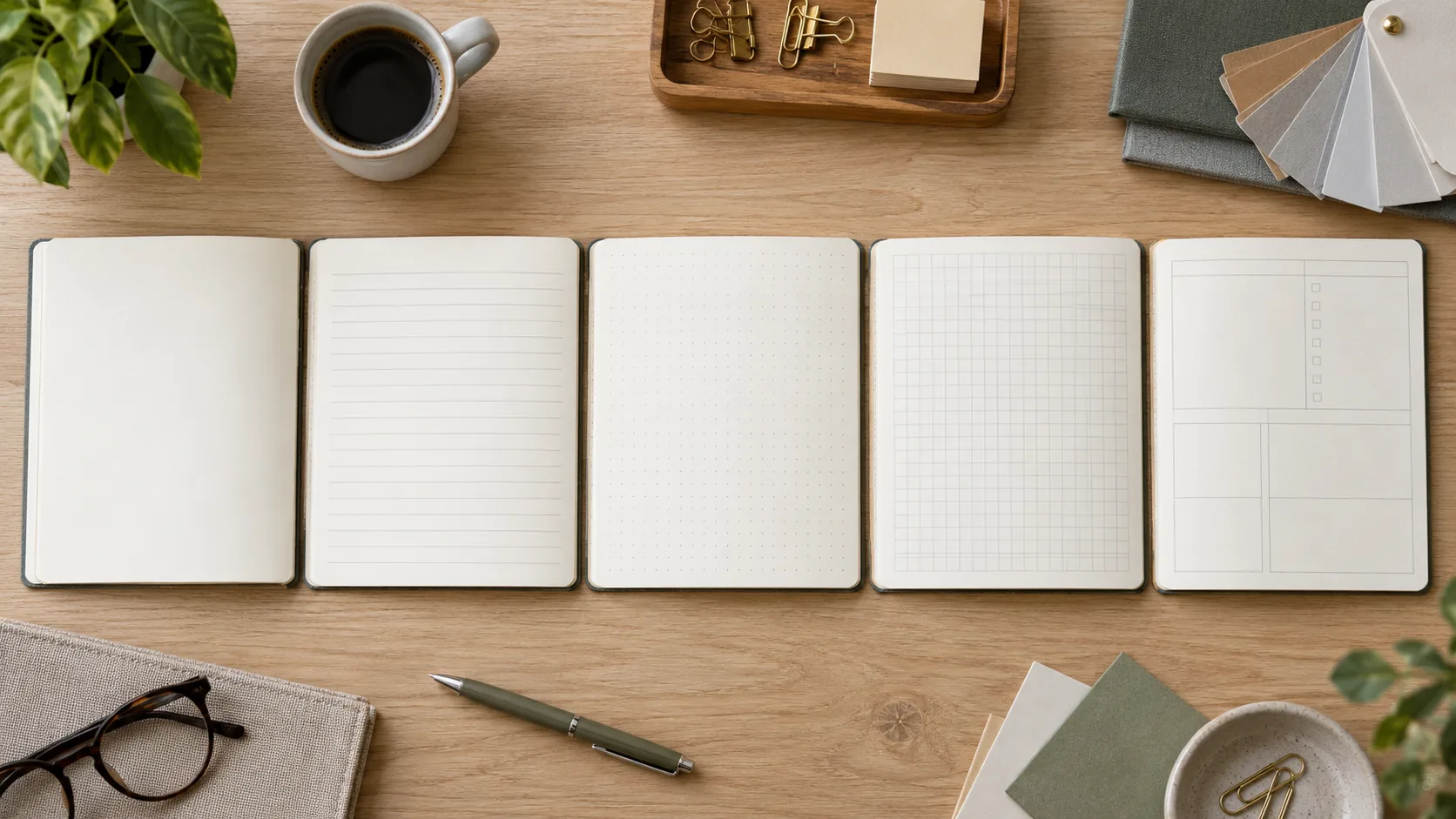
Paper and page layout change what a notebook type can do. Ruled, blank, dot-grid, graph, planner, and content-led interiors create different tasks and production questions even when the cover looks similar.
What should the inside-page brief include?
Start with the user’s action: write, plan, sketch, study, record, or follow prompts. For guided or content-led products, custom collection book printing shows why format, page count, paper, binding, cover, and finish should align before production.
Write down:
- Page system and line, dot, or grid treatment.
- Page count and whether the count means sides or physical sheets.
- Print coverage, images, prompts, indexes, or section dividers.
- Paper feel, opacity expectation, and any color or finish on the inside.
| Interior layout | Common job | Production check |
|---|---|---|
| Ruled | Notes, journaling, classroom writing | Confirm line spacing and margins |
| Blank or dot-grid | Sketching and flexible planning | Confirm margins, bleed, and grid clarity |
| Graph | Calculations, diagrams, technical work | Confirm grid scale and page contrast |
| Guided or planner | Prompts, schedules, project planning | Lock sequence, sections, and proof pages |
The interior is where a notebook earns its place in a product line. Key Takeaway: choose the page system before styling the cover because it defines the user task.
How do cover and binding choices change the finished product?
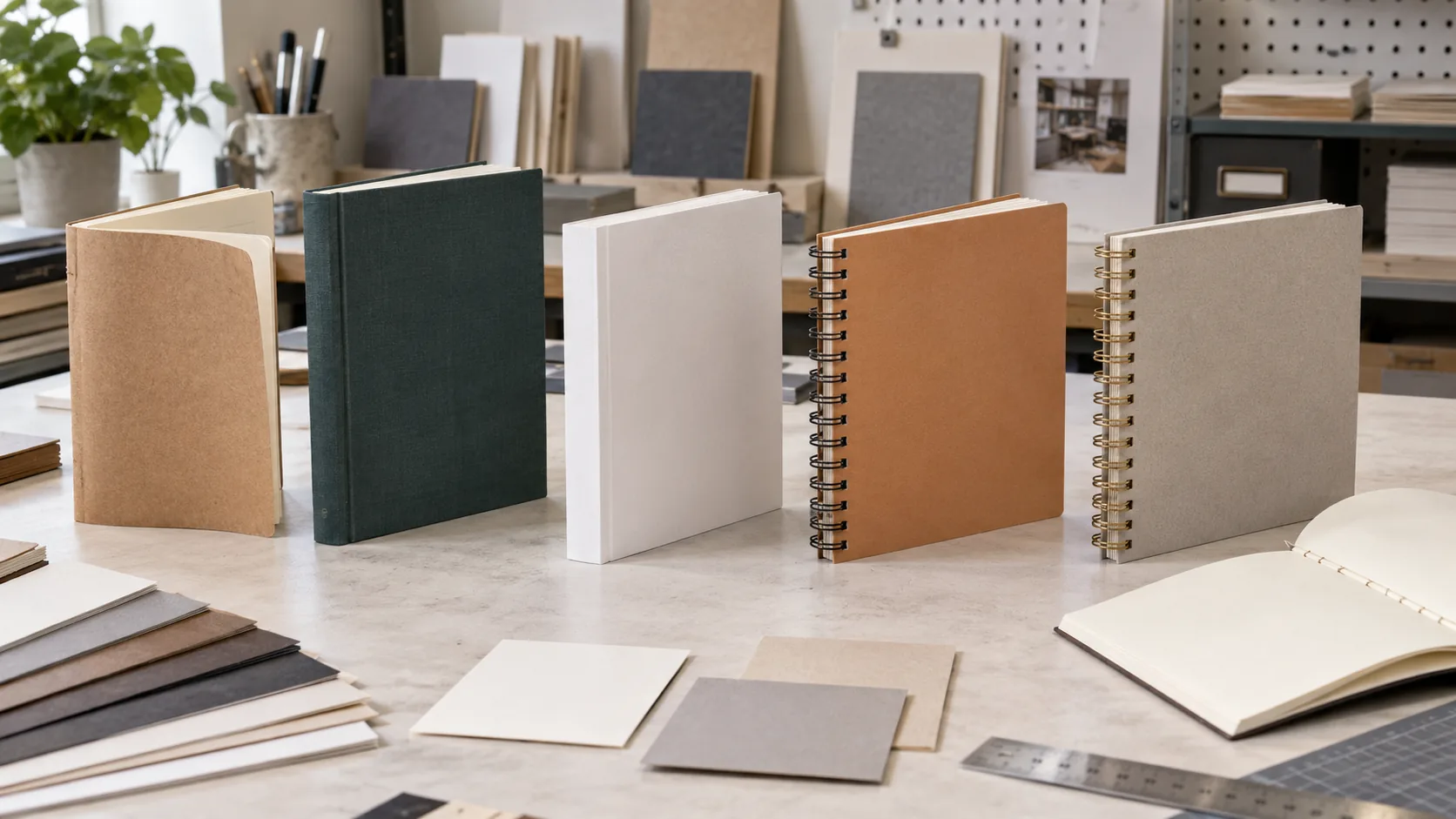
Cover and binding choices change hand feel, opening behavior, durability, shelf appearance, and how a notebook type is perceived. Softcover, hardcover, perfect bound, sewn, spiral, and Wire-O constructions work only when the user experience and page block are compatible.
What must the sample prove?
Review the complete construction instead of asking whether the cover looks good. The stationery printing planning page connects paper, binding, printing, finishing, sampling, and bulk production.
Ask the sample to prove:
- The cover stays aligned with the page block and does not feel weak or oversized.
- The binding opens in the way the user needs and holds the pages securely.
- The paper, cover, and spine produce a balanced finished object.
- The logo or surface finish remains clear on the actual material.
| Construction | User experience | Risk to check |
|---|---|---|
| Softcover bound | Light and flexible | Cover curl, edge wear, and protection |
| Hardcover sewn | Formal, durable, and more structured | Weight, spine balance, and cost fit |
| Perfect bound | Clean book-like appearance | Opening resistance and spine stress |
| Spiral or Wire-O | Easy turning and lay-flat use | Coil or wire edge, snagging, and page hold |
A physical sample turns “premium” or “practical” into observable checks. Key Takeaway: approve cover, page block, binding, and finish as one system.
How can buyers compare notebook types without comparing price alone?
Buyers should compare notebook types against the same use case, specification, sample standard, and production controls before comparing unit prices. A lower quote can become expensive if it creates corrections, inconsistent batches, or a poor market fit.

What should a supplier comparison sheet capture?
Use evidence that can be checked, not broad promises. If you are still gathering information, you can contact King Tai with a project brief containing product type, size or structure, quantity, finish preference, and available files.
Compare these items:
- Understanding: Did the supplier restate the use case and specifications?
- Sample control: Is there a physical or documented approved standard?
- Execution: Can the supplier explain how pages, cover, binding, and finish fit?
- Communication: Are revisions, packing, and next steps clear?
| Comparison criterion | Evidence to request | Decision question |
|---|---|---|
| Specification understanding | Written brief or marked sample | Are both sides using the same definitions? |
| Sample alignment | Approved physical or proof reference | What will the bulk order be measured against? |
| Production control | Clear checkpoints and review points | Where are material and print changes caught? |
| Communication and delivery | Documented revisions, packing, destination | Can the team make decisions and protect the finished product? |
Price still matters, but read it beside the evidence that protects the project. Key Takeaway: compare a supplier’s ability to control the whole notebook, not only the quoted unit.
What should you include in a notebook RFQ?
A useful notebook RFQ states the market purpose, notebook type, finished size, page plan, construction, quantity, packing needs, destination, and approval standard. If choices are open, label them for recommendation instead of leaving the supplier to guess.

How can you make the first quotation useful?
Send enough context to separate the product goal from technical unknowns. The printing project requirements guide follows the same logic: start with purpose, then align format, materials, binding, sampling, checking, and delivery.
Include the following:
- Market and use: retail, education, office, gifting, event, or guided content.
- Format: nominal label plus exact finished trim and orientation when known.
- Interior: page system, page count definition, color, sections, and inserts.
- Construction: cover, paper, binding, finish, and packaging direction.
- Commercial context: quantity by SKU, destination, and repeat-order expectation.
| RFQ field | Useful wording | Why it matters |
|---|---|---|
| Product purpose | “Retail journal for daily planning” | Sets the user and market context |
| Finished format | “Portrait, finished page block: ___” | Removes ambiguity behind size labels |
| Interior plan | “Ruled pages, ___ sides, two divider sections” | Gives the page block a real structure |
| Construction | “Softcover, Wire-O, matte surface finish” | Connects feel, opening, and production |
| Quantity, SKUs, and approval | “_ units across _ versions; bulk matches approved sample” | Sets volume and review expectations |
A clear RFQ makes a recommendation easier to assess because the unknowns are visible. Key Takeaway: describe the product’s job and finished object separately, then ask the supplier to connect them.
How should a brand choose the right notebook type?
Choose the notebook type by use case, then lock the interior, cover, binding, sample standard, and production controls. Spiral may suit practical writing, hardcover may suit premium retail, and guided or subject formats may suit structured content.

A useful brief lets a designer, buyer, and manufacturer answer the same questions: who is it for, what happens on its pages, how should it open, and what must the sample prove? King Tai can discuss those decisions with B2B buyers. Share your intended use, rough format, page plan, cover direction, quantity, and references through contact us today. Carry the product purpose into each physical detail.
Can I combine more than one notebook type in one product?
Yes. A notebook can combine a hardcover, sewn binding, dot-grid pages, and guided content. Describe each layer separately.
What’s the best notebook type for a retail stationery line?
There is no universal best type. Start with customer use, then build a repeatable range around interior, cover, and opening.
How do I know if a binding matches the page plan?
Test the physical sample at its intended thickness. Open it and write near the spine to check balance.
Can a supplier help if the notebook specifications are not final?
Often, yes. Share the market, use case, rough size, page idea, quantity, and references, then ask what must be fixed before sampling.
What should I prepare before requesting a notebook quotation?
Prepare product purpose, target user, format, page system, page count, construction, quantity, destination, and available references.