
Notebook sizes look like a simple shelf choice until a brand has to turn one into a finished product. The nominal page size sets the writing area, but page count, paper, binding, cover, and packaging change the thickness and packed dimensions. For many stationery ranges, A5 is a practical starting point; A6 suits portable notes and small-format programs; A4 gives desk users more room for reports, planning, and creative work. None of those labels should be treated as a finished cover or shipping specification.
This guide explains the nominal A-series sizes, then connects format to use, page capacity, shelf display, shipping weight, and custom trim decisions. Use the standard size to set direction, but approve the actual trimmed page block, cover, retail pack, and carton as separate specifications.
What Do Notebook Size Labels Actually Measure?
A notebook size label usually describes the nominal paper or page-block format, not the complete product. The interior, cover, and shipping pack each have different jobs.
The nominal format helps a designer plan the writing area and page layout. The finished page-block trim is the actual size of the bound interior after the production process. A cover may extend beyond that page block, while the spine changes with page count, paper, and binding. A retail sleeve, belly band, box, or protective wrap adds another measurement before the product reaches a carton.
For a new range, record these terms separately:
| Specification | What it describes | Why it belongs in the brief |
|---|---|---|
| Nominal paper size | The standard format used to plan the page area | Gives the team a shared starting point |
| Finished page-block trim | The actual trimmed interior of the notebook | Controls layout, margins, and user space |
| Cover size | The exterior size of the finished cover | Affects hand feel, shelf footprint, and branding |
| Packed unit size | The notebook with its retail protection or box | Supports storage, ecommerce, and shipping planning |
| Carton size | The outer shipper containing the agreed unit count | Supports freight, warehouse, and delivery planning |
The safest handoff uses both a familiar label and numeric measurements. A supplier can help translate the brief into a buildable specification through Kingtai’s custom notebook printing service, but the final sample should still show what each measurement means.
What Are the Nominal A4, A5, and A6 Sizes?
In the ISO 216 A-series, A4, A5, and A6 have fixed nominal paper dimensions. Values below use portrait width × height; landscape reverses the orientation.
| Format | Nominal size in millimetres | Rounded inches | Typical planning role |
|---|---|---|---|
| A4 | 210 × 297 mm | 8.27 × 11.69 in | Desk work, reports, large layouts |
| A5 | 148 × 210 mm | 5.83 × 8.27 in | Everyday journals, planners, retail notebooks |
| A6 | 105 × 148 mm | 4.13 × 5.83 in | Portable notes, quick lists, compact programs |
These nominal values align with the DIN reference for A4, A5, and A6. Each step in the A-series approximately halves the area of the previous sheet after rounding to whole millimetres: folding A4 gives the A5 relationship, and folding A5 gives the A6 relationship. That paper relationship does not guarantee that a bound A5 cover, finished trim, or retail pack will measure exactly 148 × 210 mm.
For U.S. buyers, A4 is not interchangeable with Letter paper: Letter is 8.5 × 11 inches, while A4 is narrower and taller. Confirm the exact format when the notebook must fit a printer, file, sleeve, or display fixture; the U.S. National Institute of Standards and Technology documents the Letter convention.
Put the desired finished trim in the artwork and RFQ, even when the product is marketed as A5. This prevents a familiar label from hiding a different page size, binding build, or cover footprint.
Which Notebook Size Fits Each Use Case?
The right format follows the user’s task first. Portability, writing area, shelf presentation, and price targets can then guide the construction around it.

| Format | Strong fit | What it gives the user | Main trade-off |
|---|---|---|---|
| A6 | Pocket notes, event handouts, quick lists, small gifts | Easy carrying and a compact product footprint | Less room for long entries, tables, or wide layouts |
| A5 | Journals, planners, everyday retail lines, guided content | A useful balance between writing space and portability | Too large for many pockets; thickness still depends on page count |
| A4 | Desk notebooks, project work, reports, sketches, training material | Broad writing area and larger spreads | More shelf, storage, and handling space |
| Custom | A specific user task, fixture, series, or unusual layout | A format built around the product’s actual job | Requires clearer sampling and measurement control |
A6 works when the product promise is “keep it with you.” A5 gives a brand room for structured pages without becoming a desk-only item. A4 is better when the notebook must carry diagrams, worksheets, large plans, or wide notes. A custom trim earns its place when the format itself is part of the product concept, not merely a way to make the cover look different.
For a broader view of retail, gifting, education, and event use cases, see Kingtai’s stationery and gifting printing solutions and the related notebook-printing category. Both can help a team connect a notebook’s purpose to its production choices.
How Does Size Change Writing Space and Page Capacity?
Size changes the amount of usable writing area per page, but it does not set a universal page capacity. A compact notebook may need fewer pages for quick notes, while a guided journal may need more sections, prompts, or reference pages. A larger page can hold more content per spread, yet it can also make the finished item heavier and harder to carry.
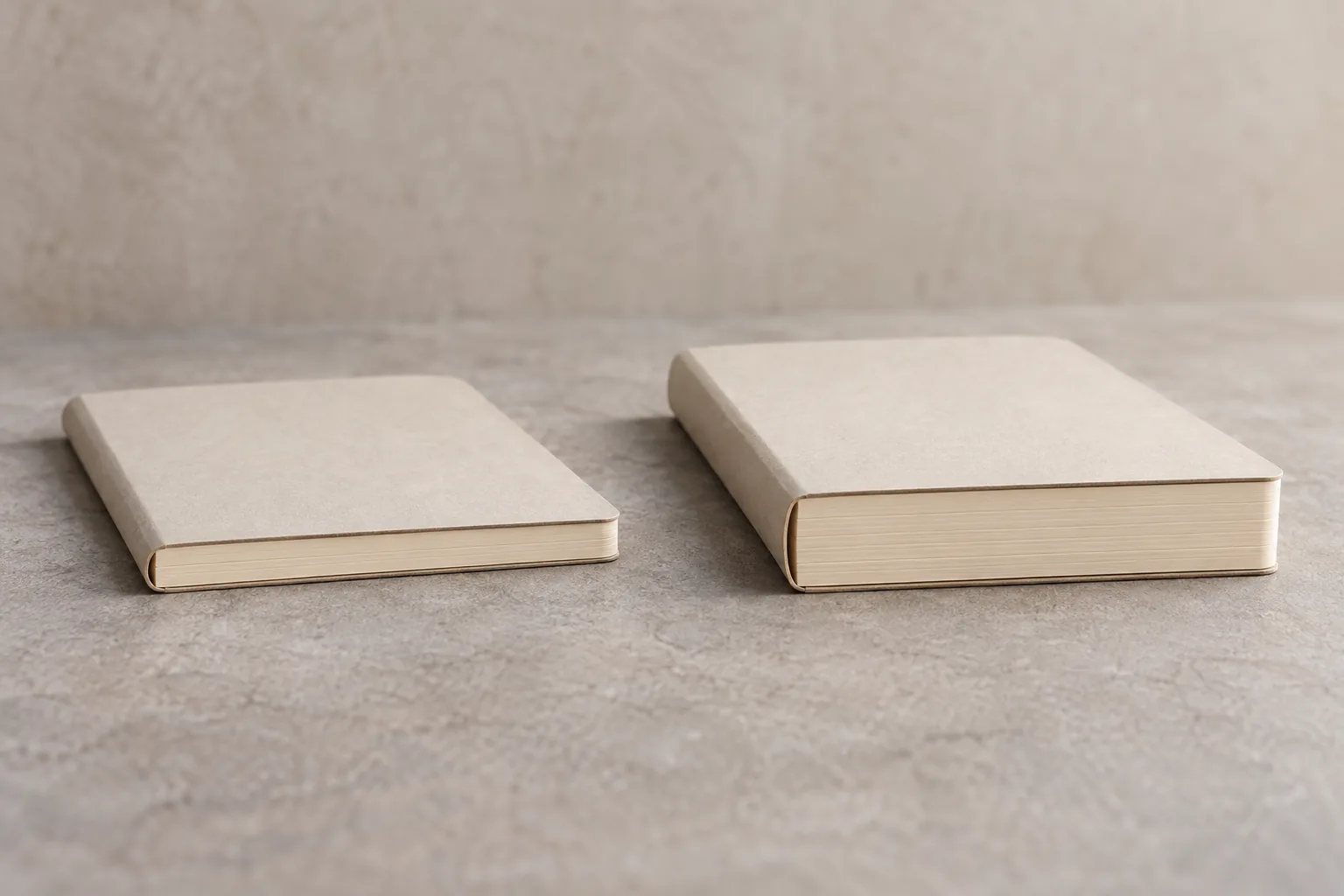
Before requesting a quote, define whether “page count” means printable sides or physical sheets. Then consider the page layout, paper weight and caliper, cover board, binding, and any foldouts or inserts. Those choices affect thickness, spine appearance, opening behavior, and packed weight together. As a quick check, ask whether an A6 product will be filled quickly or need more sections, whether an A5 planner can hold all of its spreads without becoming awkward to carry, whether an A4 workbook’s binding supports the intended thickness, and whether a custom page architecture still works at the selected trim.
Do not promise a page count from the format alone. A paper-led publishing project may need a different balance from a promotional notebook, even when both use the same nominal size. For projects that combine trim, page architecture, and binding decisions, compare the planning logic on Kingtai’s custom collection book printing page.
How Should Brands Match Size to Paper and Binding?
Size, paper, and binding should be approved as one system. A small notebook with a heavy cover or dense page block may lose its portability. A large notebook with an unsuitable binding may open poorly, put stress on the spine, or feel unbalanced on a desk.
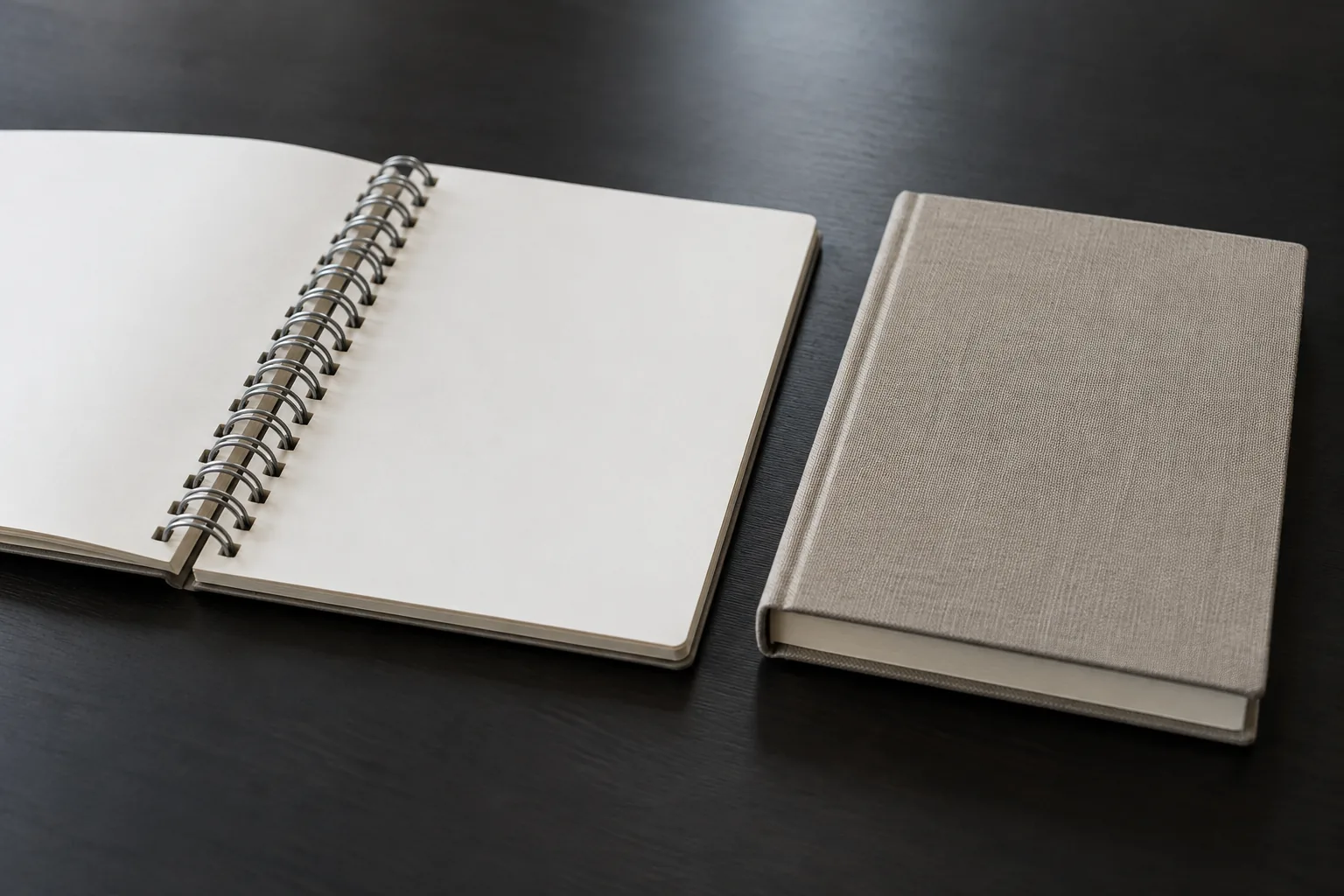
Review four connected decisions:
- Paper: Check writing feel, opacity, layout, and the effect of paper thickness on the spine and unit weight.
- Binding: Compare cover construction, page-block binding, and the opening behavior the user needs. Soft or hard covers can combine with adhesive, sewn, saddle-stitched, spiral, or Wire-O binding; a flatter opening depends on the whole build.
- Cover: Confirm material, board, surface finish, logo treatment, and how the cover sits around the page block.
- Page design: Make sure ruling, margins, bleed, images, and writing zones still work at the finished trim.
Handle, open, and write in the sample; do not judge it only on screen. If the notebook is content-heavy or book-like, a page such as Kingtai’s custom Bible printing service shows why page count, paper, cover, and binding need to be discussed together. For a notebook range, the same logic applies at a different scale.
How Does Notebook Size Affect Shelf Display?
Shelf performance depends on the notebook’s face dimensions, orientation, spine, stack, and retail pack, not only its nominal label. A product that fits the page plan may still be difficult to display if the cover, wrap, or box changes the footprint.

Use the display plan as a short decision check:
- A6: The small footprint works in grouped, stacked, or face-out sets, but the cover and label must remain visible beside larger products.
- A5: The format can work face-out, in stacks, or spine-out. Confirm shelf depth, vertical clearance, and how the cover reads at a glance.
- A4: The larger face needs more shelf depth and careful handling. It may belong on a desk or display fixture rather than a standard notebook shelf.
- Custom: Test a full-size mock-up in the intended fixture before locking artwork and packaging.
Think about the whole range. Matching A5 journals may create a coherent shelf block, while an A6 companion can work as an add-on if its label and packaging remain easy to see. A4 may need a different merchandising position rather than being treated as a larger copy of the same item.
How Does Size Affect Shipping Weight and Carton Planning?
A larger format often uses more material per page, but size alone does not determine shipping weight. Page count, paper, cover board, binding components, inserts, retail packaging, and protective packing can outweigh the difference between two nominal formats.
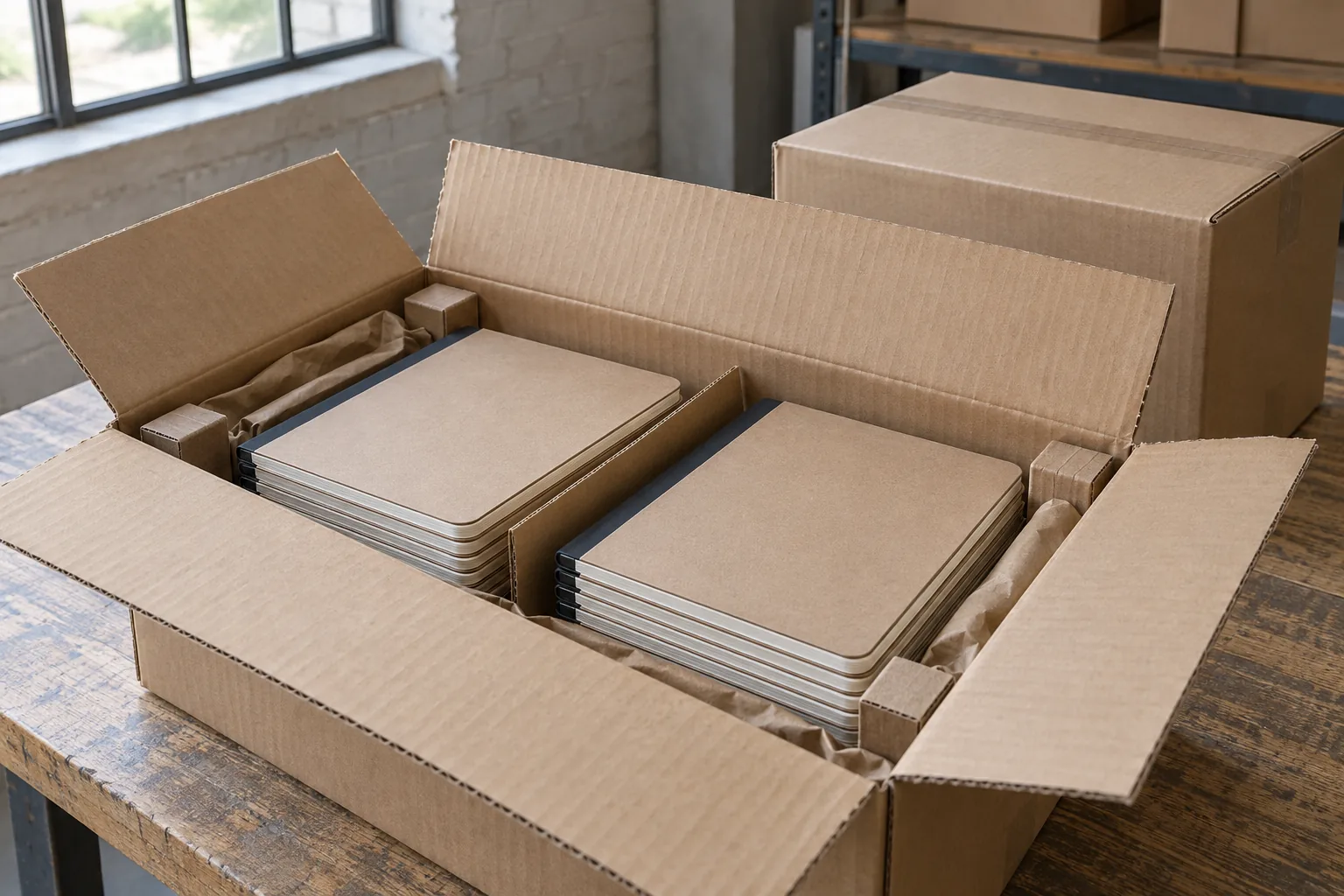
Measure the physical product at three levels:
| Measurement | When to capture it | What it supports |
|---|---|---|
| Finished notebook | After binding and finishing | Unit handling, product data, and weight comparison |
| Packed unit | After the agreed retail wrap, sleeve, or box | Storage, ecommerce, and shipment planning |
| Master carton | After the unit count and protection are fixed | Freight, warehouse space, and delivery coordination |
Use this planning equation:
carton gross weight = packed unit weight × units per carton + carton and protection weight
That is a planning equation, not a substitute for weighing a real sample. Ask for the packed-unit and carton measurements after the format, page count, binding, and pack method are confirmed. This is also where a supplier’s production and packing coordination matters more than a nominal A-series label.
When Should a Brand Choose a Custom Trim?
A custom trim makes sense when a standard A4, A5, or A6 format cannot support the user task, product series, retail fixture, or visual system. It can also be useful when a brand needs a particular landscape ratio, a dedicated planner spread, a product-specific slot, or a format that sits between established sizes.
Choose the custom route when the reason is clear:
- Define the user action: write, plan, sketch, study, gift, or carry.
- State the finished page-block width × height in millimetres and the orientation.
- Describe page count, paper, layout, cover construction, binding, and finishing separately.
- Request a physical sample showing the actual trim, cover, spine, and opening behavior.
- Approve the retail pack and carton measurements after the notebook itself is fixed.
Avoid a brief such as “A5-ish.” It leaves the designer, printer, packager, and buyer to make different assumptions. Standard sizes are easier to explain and replenish when they fit the use case. A custom format should earn its additional coordination by solving a real product or merchandising problem.
For brands developing a book or illustrated product beside a notebook range, Kingtai’s custom children’s book printing page is another relevant example of why trim, page design, and finished structure should be specified together.
What Should a Notebook Size RFQ Include?
An RFQ should separate the commercial purpose from the production measurements. A supplier can recommend options more accurately when the brief explains both what the notebook must do and what the finished product must measure.
| RFQ field | State it as | Buyer action |
|---|---|---|
| Market and use | Retail journal, planner, school notebook, gift, or campaign item | Explain the user and the selling or distribution context |
| Format | A4/A5/A6 as a starting label plus exact finished trim | Confirm portrait or landscape and the page-block size |
| Page plan | Page count, printable sides or sheets, ruling, color, and layout | Make the counting method unambiguous |
| Construction | Paper, cover material, board, binding, finish, and inserts | Ask which choices change thickness, weight, or opening behavior |
| Pack and carton | Retail protection, packed unit, units per carton, and destination | Request packed dimensions and gross weight after sampling |
| Approval standard | Artwork, physical sample, color and finish expectations | Record what the bulk order must match |
Also include quantity by SKU, replenishment expectations, and any shelf or storage constraints. Ask the supplier to return a consolidated specification sheet, not only a unit price. A notebook printing case study can help a procurement team frame questions about sample accuracy and repeat production. When the brief is ready, contact Kingtai with the format, use case, page plan, cover, binding, and packing goals.
How Should You Approve a Notebook Size for Production?
Approve notebook size in an order that protects the user experience: choose the use case, select a nominal or custom page format, confirm the exact finished trim, align page capacity with paper and binding, then verify the cover, retail pack, and carton separately.
A4, A5, and A6 are useful shared references, not complete product specifications. A5 may be the best starting point for an everyday retail notebook, A6 may make sense for portable notes, and A4 may serve desk-led content. The right answer changes when the user, page plan, shelf, or shipping model changes.
Kingtai can help brands turn that decision into a custom notebook brief covering format, page planning, binding, finishing, sampling, and production coordination. Start with the information a supplier needs to make the size real, then use a physical sample to approve what the customer will actually hold. For a broader manufacturing conversation, visit the Kingtai Printing & Packaging homepage.
FAQ 1: Does A5 have half the area of A4?
Approximately. A5 is the next size after halving A4 along its long edge, but whole-millimetre rounding makes the printed areas slightly different from an exact 2:1 ratio. A bound notebook can also have a different finished trim or cover size, so confirm actual measurements in the production brief.
FAQ 2: Should a brand quote A4, A5, or exact millimetres?
Use both. The A-series label gives the team a familiar reference, while exact finished page-block dimensions remove ambiguity about trim, orientation, cover, and pack measurements.
FAQ 3: Which notebook size is best for everyday retail?
A5 is often a balanced starting point because it offers useful writing space without being a desk-only format. The final choice should follow the user task, page plan, shelf, and carry requirements.
FAQ 4: Does a larger notebook always weigh more?
No. Page count, paper, cover, binding, inserts, and retail packaging all affect weight. Weigh a finished and packed sample instead of estimating shipping weight from the nominal format alone.
FAQ 5: What should we request before approving production?
Request a physical sample and a written specification covering the finished page-block trim, page count definition, paper, cover, binding, finish, packed unit, carton, and approval standard. That record gives the bulk order a clear reference.