The different types of notebook paper should be chosen by the user’s task first, then by the paper surface, page pattern, and print structure that support it. A stationery buyer may approve a page design on screen and later discover that the ruling is too strong, ink shows through, or the stock feels wrong. Those problems become expensive after the cover and binding are fixed.
Plan paper by separating the page pattern from the stock. Once you know whether the product needs ruled, blank, dot-grid, graph, or guided pages, compare writing feel, print coverage, thickness, and production risk.
What are the different types of notebook paper?
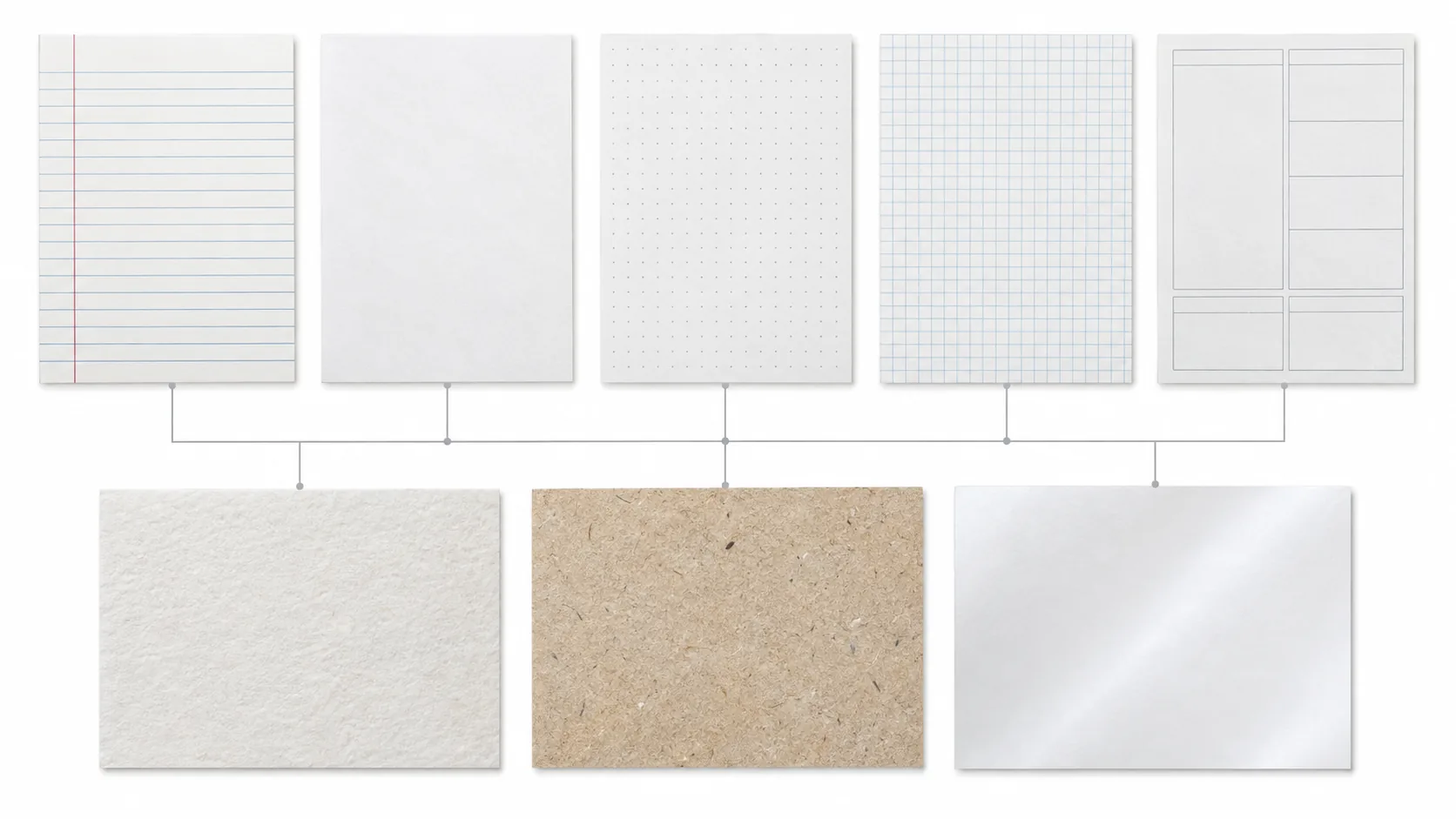
The different types of notebook paper fall into two groups: the page pattern the user sees and the stock that carries it. Ruled, blank, dot-grid, graph, and planner pages describe layout, while writing or uncoated, recycled, and coated stocks describe material and surface direction.
How should a buyer separate the two axes?
Treat the page pattern and stock as separate decisions in the brief. King Tai’s custom notebook printing service connects inside pages, paper, binding, cover, finishing, and sampling because a notebook type is a finished product, not a paper label.
Start with these questions:
- What will the user do? Write, draw, calculate, plan, study, or follow prompts.
- What should the page feel like? Smooth, textured, flexible, firm, white, or warm in appearance.
- What must the printer reproduce? Lines, dots, grids, images, margins, or dividers.
- What must the bound product support? Page count, opening, spine, weight, and packing.
| Decision axis | Examples | Best buyer question |
|---|---|---|
| Page pattern | Ruled, blank, dot-grid, graph, planner | What task should the page ease? |
| Paper stock | Writing/uncoated, recycled, coated | What surface and print behavior are required? |
| Print treatment | Lines, dots, grids, images, prompts | What must stay clear after trimming and binding? |
| Finished structure | Page count, cover, binding, pack | How will the paper behave as a complete notebook? |
The two axes are easier to compare when they appear as separate lines in the RFQ. Key Takeaway: define the user task, page pattern, paper stock, and finished structure as four related but different decisions.
How do ruled, blank, dot-grid, and graph pages differ?
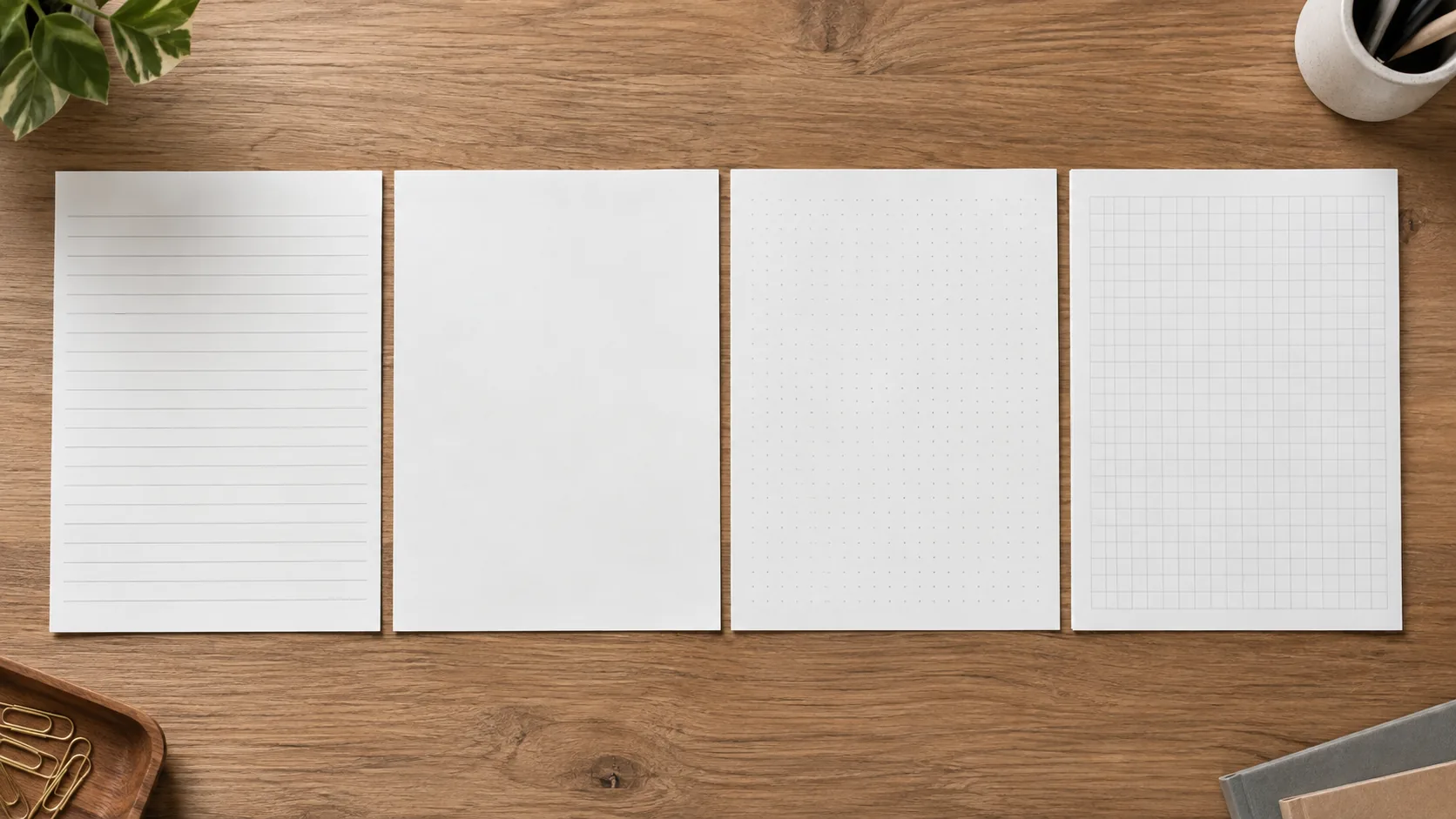
Ruled, blank, dot-grid, and graph pages guide different actions. Lined paper supports writing, blank pages give freedom, dots give light structure, and graph paper supports measured layouts or calculations.
Which page pattern fits each user task?
Choose the page pattern before asking for decorative cover options. King Tai’s stationery and gifting printing solutions groups notebook projects by retail, education, internal, gifting, and event use, which helps connect layout to the real distribution context.
Check the page proof for:
- Line or grid visibility at normal reading distance.
- Margin position, ruling direction, and usable writing area.
- Whether the pattern supports both sides of the sheet.
- Alignment after trimming and binding.
| Page pattern | Strong fit | Range position | Approval check |
|---|---|---|---|
| Ruled | Notes and journaling | Everyday or school line | Review spacing, margins, and line weight |
| Blank | Sketching, creative work, open planning | Flexible or premium line | Check bleed, margins, and page balance |
| Dot-grid | Flexible planning and structured notes | Journal or planner line | Confirm dot scale and print subtlety |
| Graph | Maths, diagrams, technical work | Study or specialist line | Confirm grid clarity and trim alignment |
| Guided | Prompts and schedules | Content-led line | Lock sequence, sections, and proof pages |
The page pattern is part of the product promise. Key Takeaway: choose the layout from the user’s action, then make its printed details easy to read and repeat.
Which notebook paper works best for everyday writing?
Writing or uncoated paper is often a practical starting point for everyday notebooks because it supports handwriting, printed ruling, and regular handling. The right choice still depends on the tools, hand feel, and print coverage.

What should brands compare before choosing writing stock?
Use the custom printing services discussion to align content format, paper, binding, sampling, and production checks. Avoid choosing a stock only because it sounds familiar; the surface, opacity, shade, and thickness need to fit the actual notebook.
Compare these priorities:
- Writing feel: smoothness and texture should suit the tools.
- Show-through: the reverse side should remain usable.
- Printed ruling: lines, dots, or grids must stay clear without dominating the page.
- Finished weight: paper choice changes thickness, handling, and packing needs.
| Buyer priority | Paper direction | Trade-off | Test |
|---|---|---|---|
| Easy everyday writing | Writing or uncoated stock | Surface feel varies by formulation | Use representative pens on both sides |
| Strong page appearance | Stock with suitable shade and opacity | More controlled appearance may affect cost | Compare the printed and blank page under the same light |
| Flexible office use | Balanced surface and thickness | One compromise may not suit every tool | Test representative writing tools |
| Cost-aware volume line | Simple, repeatable stock specification | Lowest quote may not give the right feel | Compare sample feel with bulk specification |
The safest choice works for the intended tools and complete notebook. Key Takeaway: treat writing paper as a user-experience decision, not a generic interior default.
How should brands choose paper for pens and ink?
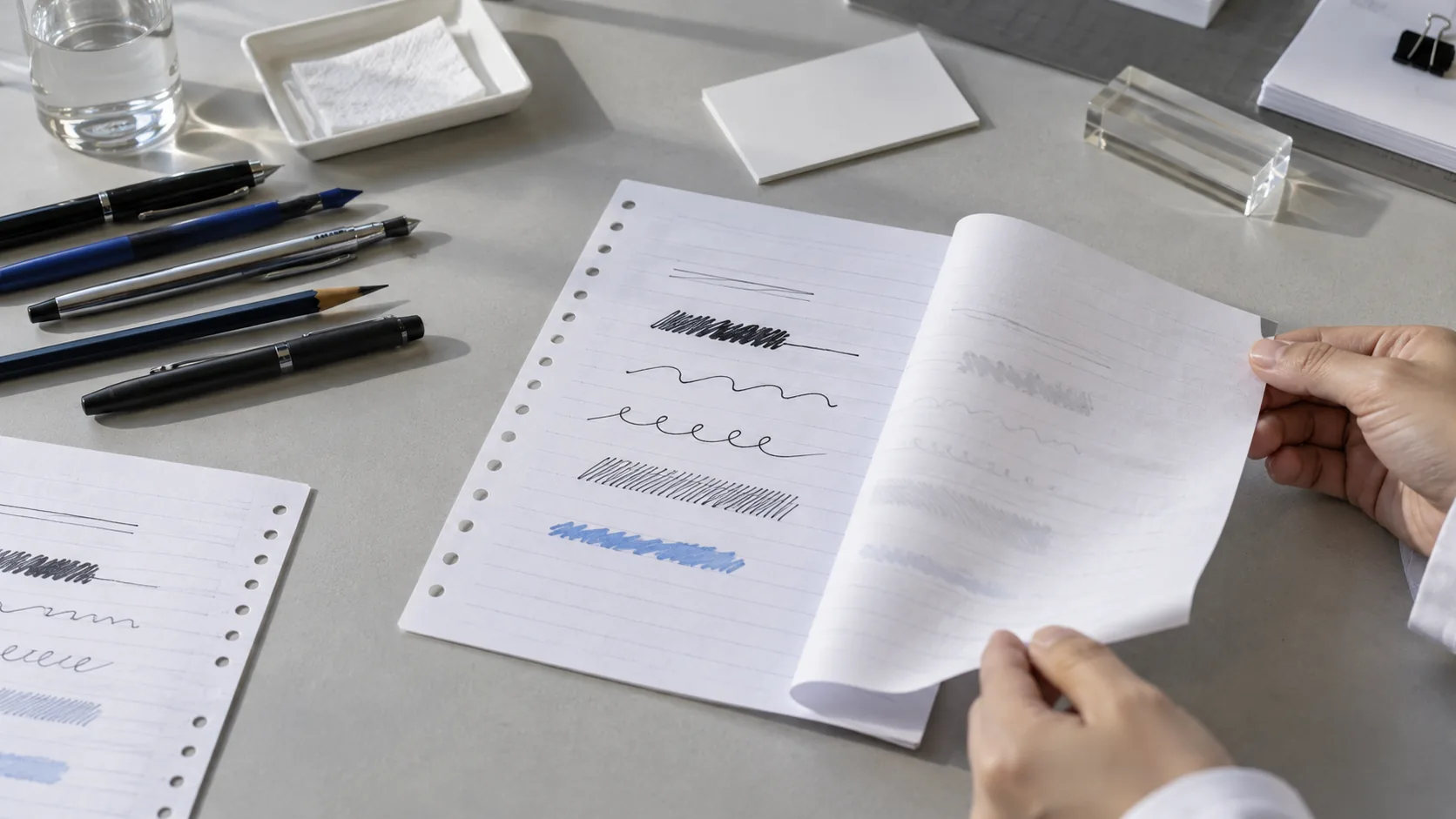
Brands should choose paper for pens and ink by testing bleed-through, show-through, drying, smearing, and line clarity with the tools customers will use. A paper that feels good with a ballpoint may behave differently with gel, marker, or fountain pen.
What should an ink test include?
A physical test should use the selected paper, printed ruling, and finished page setup. The notebook printing case study shows why sample accuracy and repeatable output matter.
Test more than one writing situation:
- Write on the front and back of the same sheet.
- Check the page immediately and again after drying.
- Compare normal and heavier writing pressure.
- Turn and stack pages to see whether ink transfers.
| Writing tool | Risk to watch | Sample method |
|---|---|---|
| Ballpoint | Uneven feel or line drag | Write notes and headings |
| Gel pen | Show-through, drying, or transfer | Test filled areas and turn pages after drying |
| Marker | Bleed-through and page damage | Test the marker class used by the audience |
| Fountain pen | Feathering, bleed-through, and slow drying | Use representative nib and ink combinations |
| Pencil | Smearing and surface resistance | Erase a sample and inspect the page |
This test gives evidence instead of a broad compatibility promise. Key Takeaway: test ink on the intended page pattern, then record the approved paper and tool conditions.
Does recycled paper suit a notebook product line?
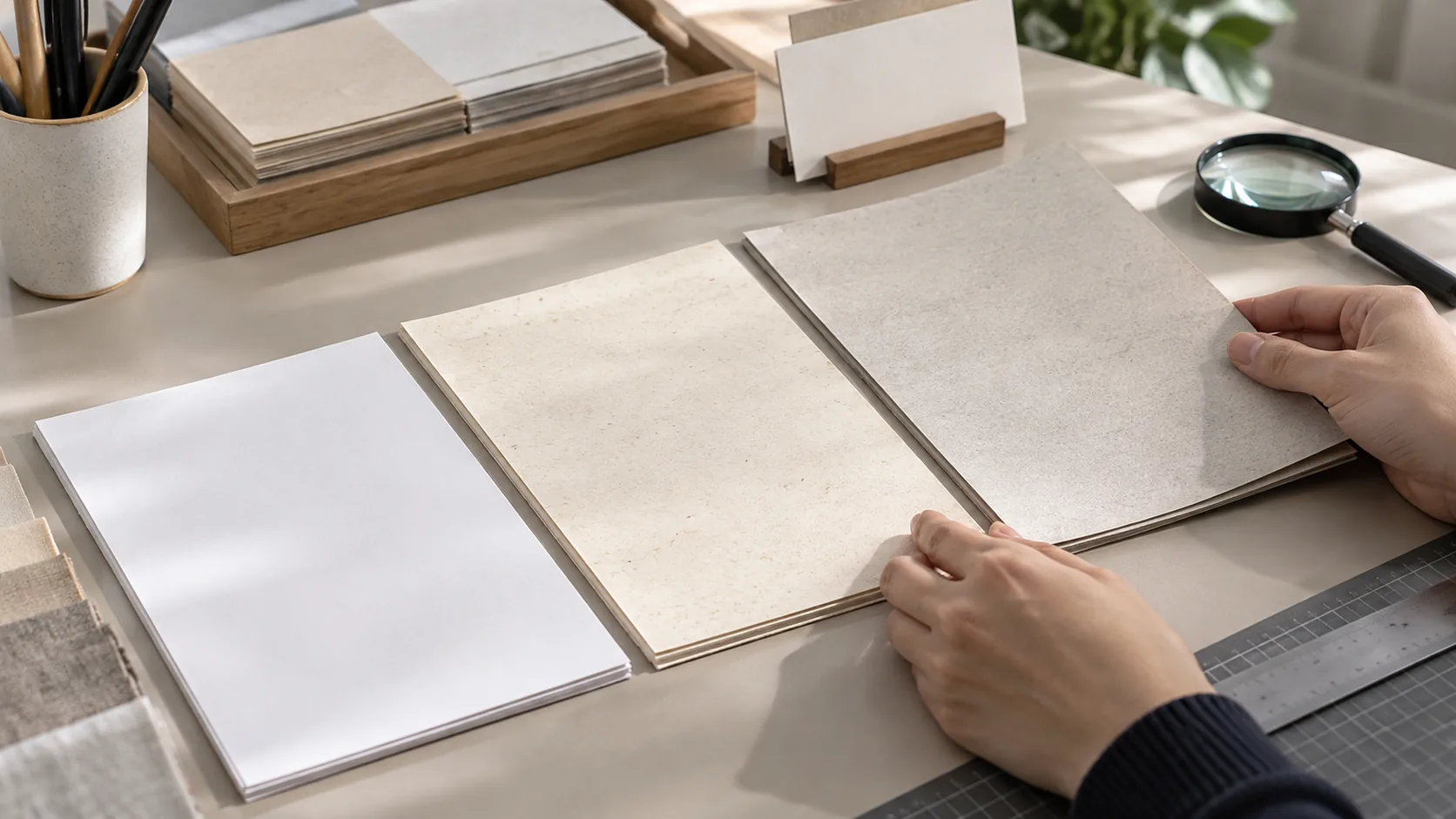
Recycled paper can suit a notebook line when its appearance, writing feel, print behavior, and consistency support the brand’s product goal. It should be evaluated as a defined paper specification rather than assumed to be interchangeable with every other writing stock.
What should buyers verify about recycled stock?
Use a paper sample and written specification to discuss the surface, shade, opacity, print result, and available consistency. The current custom notebook formats page emphasizes matching paper and inside pages to the project’s use and production direction.
Ask for evidence on:
- The paper’s declared composition and appearance standard.
- Shade and surface consistency across the approved sample and bulk stock.
- How printed lines, dots, images, or solid areas appear on the surface.
- Whether the finished thickness and handling suit the chosen binding.
| Buyer goal | Question to ask | Evidence |
|---|---|---|
| Recycled positioning | What paper specification is being quoted? | Written stock description and sample |
| Natural appearance | How will shade and surface vary? | Samples under the intended light |
| Clear ruling | Will lines or grids remain legible? | Printed page proof |
| Repeat production | How is the approved appearance referenced? | Sample standard and production record |
If an FSC claim is planned, check the supplier’s documentation against the FSC label guidance. Avoid environmental percentages or certification statements without evidence. Key Takeaway: recycled paper can be a sound product choice when its physical and print characteristics are documented before approval.
When is coated paper appropriate for notebook interiors?
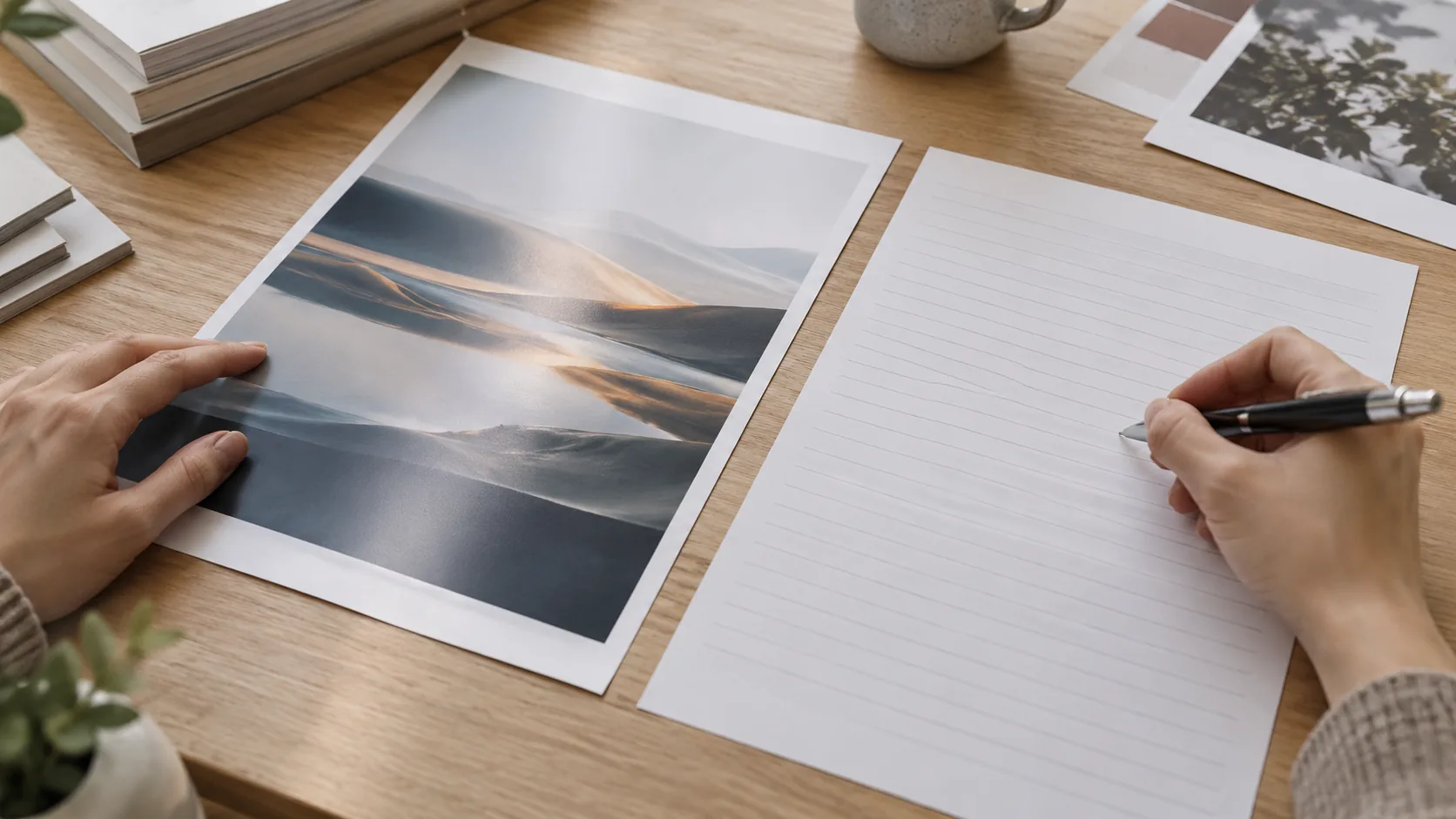
Coated paper may fit interiors with substantial images, color fields, or other printed content, but writing-led notebooks need a separate usability check. Coating should solve a content need rather than signal “premium” by itself.
How should buyers balance images and writing?
For image-led or guided products, custom collection book printing shows why paper, print coverage, page count, binding, and finish must work together. A surface that reproduces images well may still need writing tests.
Compare the project’s real need:
- Image-led pages: confirm color, detail, reflection, and page turning.
- Writing-led pages: confirm pen feel, drying, show-through, and handling.
- Mixed pages: decide between different stocks and a consistent compromise.
| Content need | Surface direction | Main risk | Sample check |
|---|---|---|---|
| Image-heavy content | Surface selected for print reproduction | Writing feel may be secondary | Review images and write on a sample page |
| Everyday writing | Writing-oriented stock | Color or images may need a compromise | Test tools on both sides |
| Guided or planner pages | Stock matched to prompts and print density | Heavy areas can affect writing zones | Inspect prompts, lines, and open spreads |
| Mixed product | Deliberate section or stock strategy | More specification complexity | Approve the full page sequence |
The right question is whether the page performs its job after printing. Key Takeaway: choose coated or surface-treated paper for a defined content requirement, then test the writing experience before scaling up.
How do paper surface and weight affect the finished notebook?
Paper surface and weight affect hand feel, page thickness, spine width, opening behavior, unit handling, and cost. These effects are connected: adding pages or choosing a heavier stock can change the finished structure even when the cover design stays the same.

Which paper variables belong in the production brief?
The stationery printing planning page treats paper, binding, finishing, sampling, and delivery as linked decisions. Record the paper direction beside page count and binding instead of hiding it inside a general “premium paper” request.
Specify and test:
- Surface direction: smooth, textured, coated, or writing-oriented.
- Shade and opacity expectation under the intended lighting.
- Page count definition and the resulting page-block thickness.
- Binding, cover, packing, and handling implications.
| Paper variable | Product effect | Buyer check |
|---|---|---|
| Surface | Changes feel, print appearance, and writing interaction | Compare a blank and printed sample |
| Thickness | Changes bulk, spine, weight, and opening | Approve a physical dummy |
| Shade | Changes contrast, mood, and brand presentation | View under the intended light |
| Opacity | Changes reverse-side visibility | Test the actual page content and tools |
| Page count | Changes thickness, cost, and binding fit | Define sides versus sheets clearly |
Paper is part of the notebook’s physical architecture. Key Takeaway: approve surface and weight with a page block, cover, and binding, not as a loose swatch.
How should paper and ruling work together in a retail range?
Paper and ruling should form a repeatable architecture across a retail range, with each SKU offering a clear use rather than a random variation. A lined everyday notebook, a dot-grid planner, and a recycled journal can share a cover family while serving different users.

How can a range stay clear for buyers and suppliers?
Use a short specification for every interior family. The printing project requirements page supports this approach by starting with product purpose, then matching format, material, binding, sampling, checking, and delivery.
Give each SKU a defined role:
- Everyday: writing-oriented stock and ruled pages.
- Planning: dot-grid, graph, or guided pages with a clear structure.
- Creative: blank or lightly guided pages with more open space.
- Responsible-material line: documented recycled stock with a defined appearance.
| Range role | Page pattern | Stock direction | Production question |
|---|---|---|---|
| Everyday notebook | Ruled | Writing-oriented | Can the base stock repeat across SKUs? |
| Planner | Dot-grid or guided | Writing and print balance | Is the page sequence locked before sampling? |
| Creative notebook | Blank or light grid | Smooth or textured by task | Does the surface support the intended tools? |
| Recycled line | Ruled or dot-grid | Documented recycled stock | How will shade and consistency be controlled? |
This structure makes a retail range easier to explain and quote. Key Takeaway: make every paper-and-ruling combination earn its place through a distinct user task.
What should buyers test before approving notebook paper?
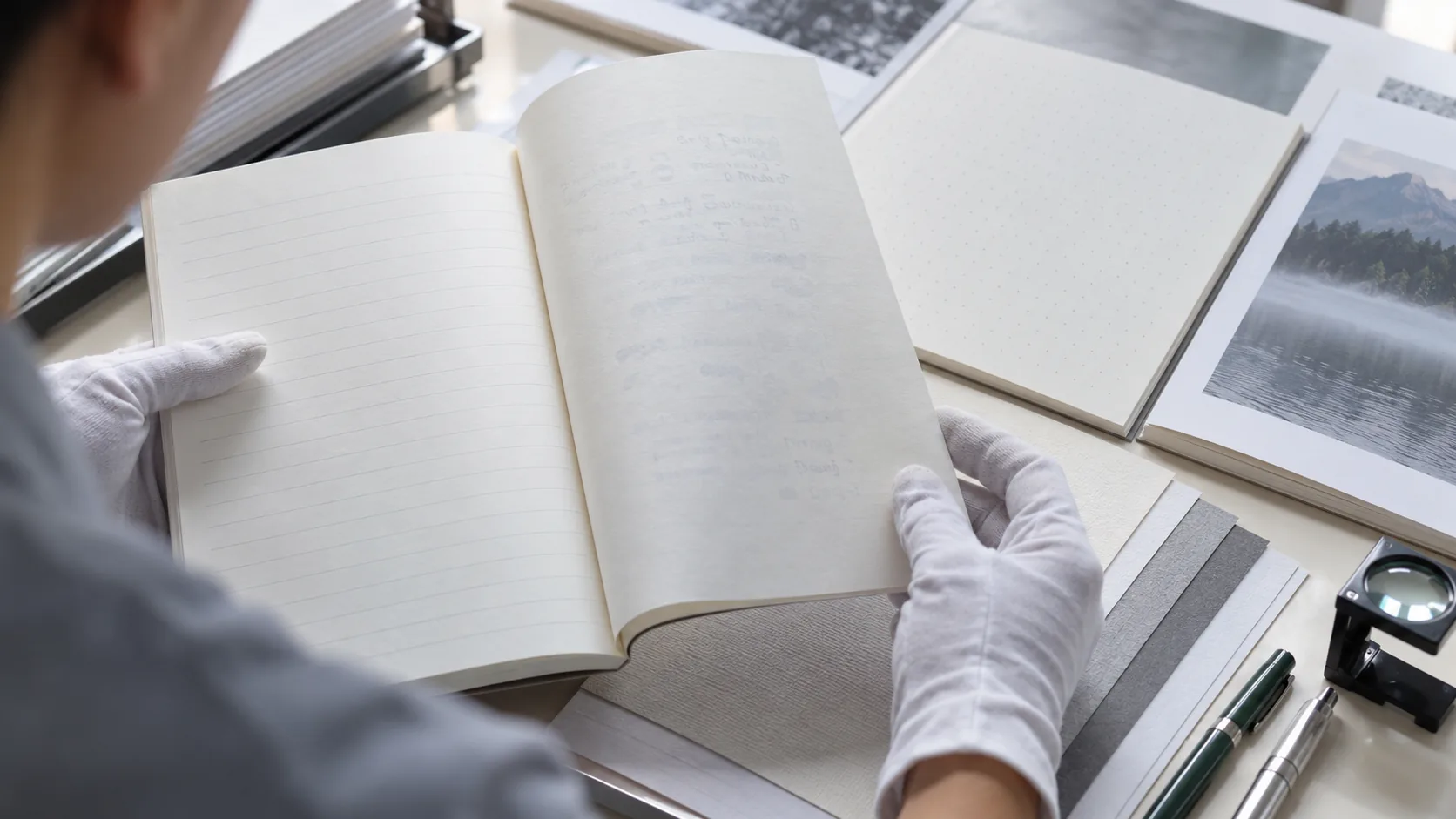
Buyers should approve notebook paper only after testing the printed page, writing interaction, finished thickness, and binding context together. A swatch cannot prove how the final notebook will open, stack, or perform.
What belongs on the paper approval checklist?
Send a clear brief through contact King Tai with your notebook requirements with the use case, page pattern, paper direction, quantity, and available artwork. Ask which decisions remain open before sampling.
Check these points:
- Page pattern, line weight, margins, and trim alignment.
- Writing tools on both sides after drying.
- Surface, shade, opacity, and printed color under consistent light.
- Page-block thickness, binding, packed unit, and approved repeat standard.
| Checkpoint | Evidence | Approval question |
|---|---|---|
| Page pattern | Printed page proof | Are the lines, dots, or grids clear and aligned? |
| Writing behavior | Pen and ink test on both sides | Can the intended user write without unacceptable show-through? |
| Surface and shade | Sample under consistent light | Does the page feel and look right for the range? |
| Finished structure and repeat | Bound sample plus specification | Does paper fit the binding, and what will bulk match? |
Paper approval is a product decision, not a last-minute material check. Key Takeaway: approve the page as the customer receives it, then keep the sample and specification together.
How should a brand choose the right notebook paper?
Choose notebook paper by separating the page pattern from the stock, then test writing behavior, print coverage, surface, thickness, binding fit, and repeat-production requirements in a physical sample. Page patterns solve different tasks, while writing, recycled, and coated stocks create different production choices.

The strongest brief tells a designer, buyer, and manufacturer what the page must do, what it should feel like, which tools will be used, and what the sample must prove. King Tai can discuss those decisions with B2B buyers before the paper choice is locked.
Share the use case, page pattern, paper direction, page count, binding, quantity, and references through contact us today. A clear paper decision gives the rest of the specification something reliable to build on.
Can I use the same paper for every notebook type?
Sometimes, but not automatically. Writing, planning, image-heavy, and recycled products may need different surface or opacity priorities.
What’s the best paper for everyday notebook writing?
Writing-oriented or uncoated stock is a practical starting point. Confirm surface and opacity with the pens, ruling, and binding used in the finished product.
Does recycled paper always look different?
Not always. Shade and surface depend on the specified stock, so compare a physical sample and document the appearance standard.
How do I test bleed-through and show-through?
Use the actual tools on both sides of a representative page, inspect immediately and after drying, and compare with the approved standard.
What should I send before requesting a quotation?
Send the user task, page pattern, paper preference, page count, size, binding, quantity, destination, and available references.